
Fast Facts: Esther is the only book of the Bible that doesn’t mention God. Esther is one of two books in the Bible named after a woman. The other is Ruth. Esther and Mordecai come from the tribe of Benjamin. They are distant relatives of King Saul.
Esther takes place just after the time of Daniel. Mordecai was alive at the same time as Daniel but Esther would be born later. She and Mordecai surely saw the effects of Daniel’s legacy on the empire. It may have been the stories of Daniel and his friends that gave Esther the courage she needed to stand up for her people.
We don’t see Esther in the first chapter. Vashti is queen (and granddaughter/great-granddaughter of Nebuchadnezzar according to Jewish midrash) and she gets ousted for not following the kings instructions of showing off her beauty to all his drunken guests. After some time passes, a beauty pageant of sorts is given. Only this is more like sex trafficking of minors than a regular beauty pageant. No girl in her right mind wants this, much less a God-fearing Jewish girl.
Esther or Hadassah, her Hebrew name meaning Myrtle, is “taken” along with many other girls to the kings palace. Older cousin and care taker Mordecai is powerless to stop this. The girls are given a full year of beauty school including six months of oil and myrrh and six months of spices and cosmetics. During this time, Esther finds favor with Hegai, the eunuch in charge of the women. (This sounds like the favor that Joseph and Daniel both had when in captivity.)
When it’s Esther’s turn to go in to the king, we learn that he delighted in her and summoned her by name. She was then named Queen of Persia.
Right after Mordecai discovers a plot against the king, we meet our villain, Haman. He is an Agagite. Remember King Agag who Saul failed to utterly destroy? Yep, we see his descendants here to wreck havoc on the Jewish people again. He wants to “destroy, kill and annihilate” all the Jews. All because Mordecai refused to bow to him.
Haman had the scribes write the edict on the thirteenth day of the first month. That’s the day before Passover. While the Jews in that area celebrate a time of God’s deliverance from Egypt, an edict calling for their destruction went out into all the provinces.
When the Jews find out about the edict, there is mourning and weeping in sackcloth and ashes. Mordecai pleads with Esther to go see the king, but she is fearful and reminds him of the punishment of going in without an invitation. His response is one of the most well know verses in the Bible:
14 For if you remain silent at this time, relief and deliverance will arise for the Jews from another place and you and your father’s house will perish. And who knows whether you have not attained royalty for such a time as this?” Esther 4:14
Esther requests prayer and fasting for three days and ends her request with:
“…And thus I will go in to the king, which is not according to the law; and if I perish, I perish.” Esther 4:16b
Thankfully, the King holds out the golden scepter for Esther and she requests his presence along with Haman to a banquet. The banquet is a big success and Esther asks for them to come again soon. Haman is on cloud nine but when Mordecai doesn’t bow to him, he is filled with rage. His wife suggests he build a gallows 75′ high to hang Mordecai on and he does just that.
Then that night the king can’t sleep.
This is where everything changes.
The book of Esther has perfect chiastic structure. Everything up to this point is about to be reversed. See the chart below.
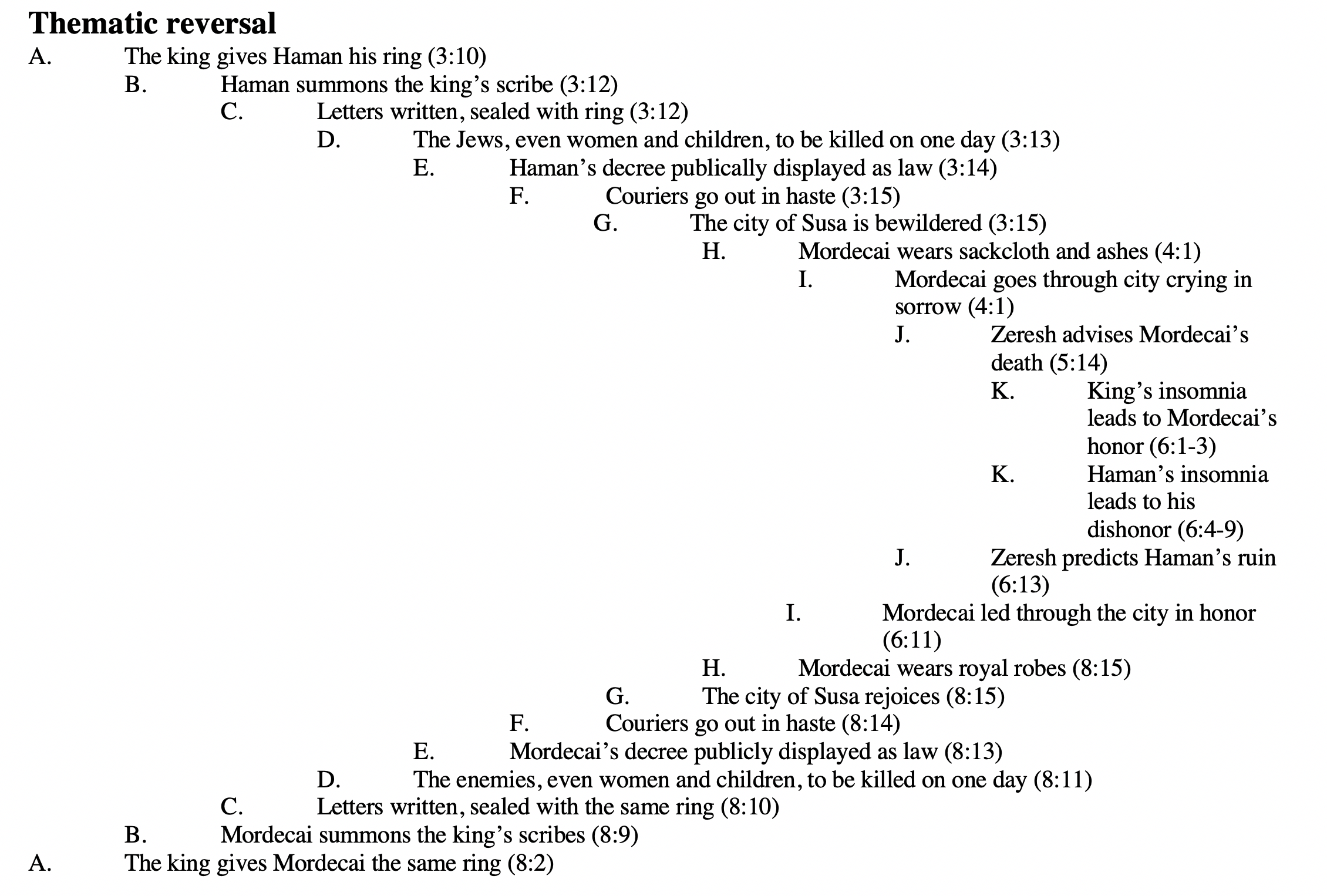
Haman didn’t stand a chance. God was working all things for good just like He always does. God likes to turn things around and use the weapons of the enemy for His glory. He did it with Jesus on the cross. What Satan meant for harm ended up being the very thing that secured his destruction and freed the rest of us.
Haman ended up on the same gallows he had built for Mordecai. Now Mordecai and Esther had the task of protecting their people from the edict that was sent out by Haman. All they could do was create a new law to give them a fighting chance and it was successful.
The Feast of Purim is instituted after these events to commemorate the day the Jews rid themselves of their enemy and everything was turned for them from sorrow to gladness and from mourning into a holiday. Purim is not one of the original seven holidays given by God but is a holiday, like Hanukkah that come decades later, that celebrates a great deliverance. The typical Purim holiday today looks like a mix of Halloween and Mardi Gras with costumes, candy and parades. The scroll of Esther is read for all to hear and everyone cheers when Mordecai is mentioned and noise is made when Haman is mentioned. The traditional food served is Hamantaschen or “Haman’s ears”. They are triangle shaped sugar cookies filled with fruit.
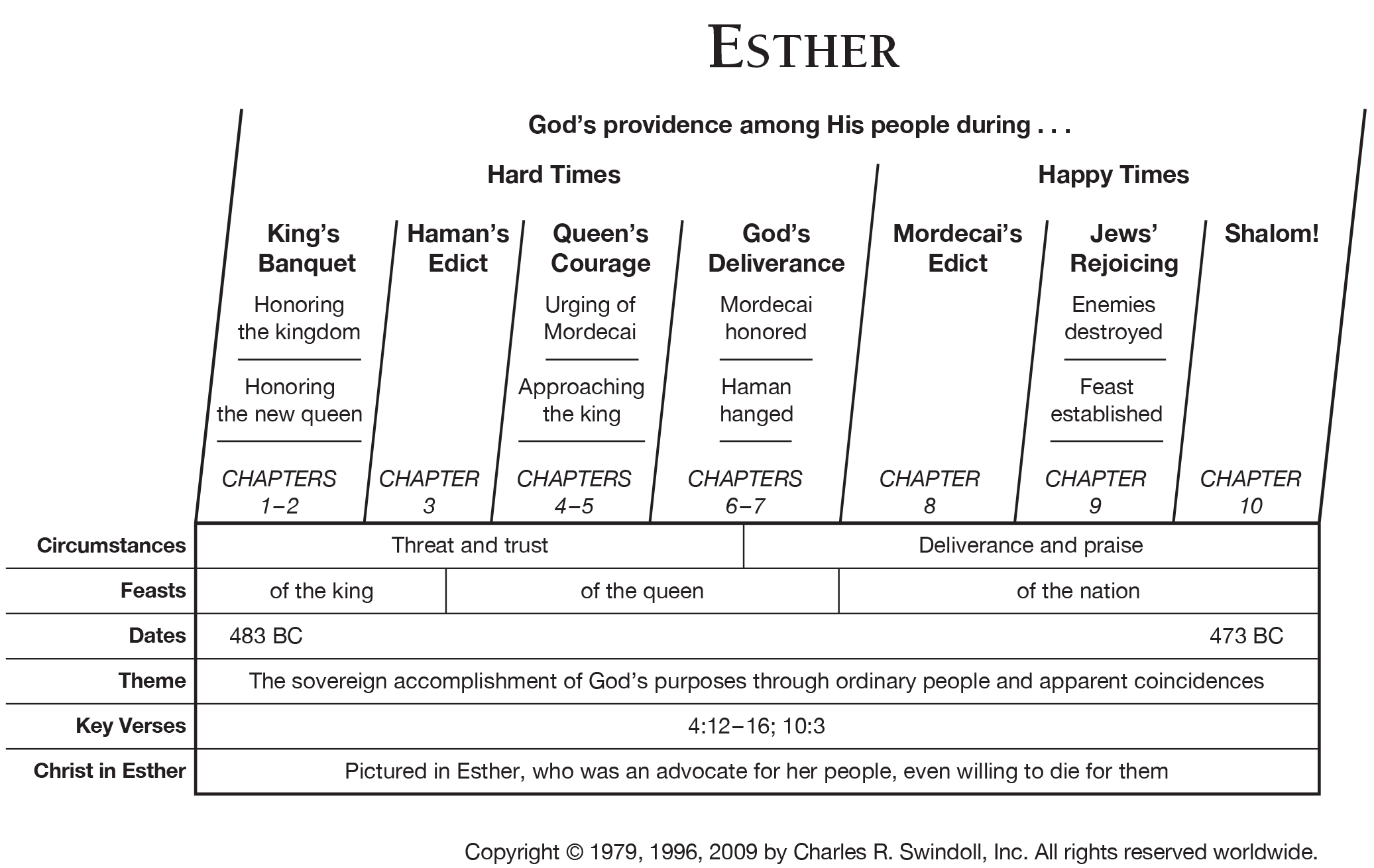
Below is a chart I put together showing many of the things that happened from the time of Daniel to the time of Jesus. All four of the beasts in Daniel’s vision have come on the scene and the culture has changed drastically for the Jewish people and the whole world.
Extra Charts and Resources:
Articles:
Hebrew for Christians: The Fast of Esther
The Bible Project Blog: Esther – Secular or Sacred?
Podcasts:
The Bible Recap Podcast: Esther 1-5
The Bible Recap Podcast: Esther 6-10
Teaching Videos:
The Bible Project Video: Esther
Cornerstone Chapel teaching video: Esther 1 The Dignity of Women
Cornerstone Chapel teaching video: Esther 2 The Misery of our Glory
Cornerstone Chapel teaching video: Esther 3-4 For Such a Time as This
Cornerstone Chapel teaching video: Esther 5-7 When Plans Backfire
Cornerstone Chapel teaching video: Esther 8-10 Turning the Tables
 Theresa Haigler