
1. Welcome to the Biblical Holidays
Have you ever wondered what life was like for Jesus growing up in a Jewish family? What traditions did His family observe? What celebrations did they look forward to each year? And what did those celebrations mean?
Those questions led me to explore the biblical holidays, and what I learned changed the way I read Scripture!
I’ve always known that Jesus is our Passover Lamb. But participating in celebrations such as a Passover Seder helped me appreciate the biblical imagery behind that truth. Today’s Seder includes customs that developed after Jesus’ time, so it isn’t an exact reenactment of the Last Supper. Still, studying Passover gave me a deeper appreciation for the events surrounding His death.
I’m someone who learns by doing. My hope is that exploring these holidays together will help you see familiar Bible stories in a whole new light. We’ll begin with what these observances meant to Israel, then discover how they illuminate the world of Jesus and the New Testament.
2. God’s Appointed Times
In Leviticus 23, God calls these observances “My appointed times” (Leviticus 23:2, NASB). The Hebrew word mo’ed (moh-ED; plural mo’adim) means an appointed time or meeting. It also appears in Ohel Mo’ed, the “Tent of Meeting.”
Think about that! God appointed both a place of meeting and times for His people to gather before Him.
These days invited Israel to rest, worship, remember God’s mighty acts, celebrate His provision, and teach the next generation. Leviticus 23 begins with the weekly Sabbath, then moves through the annual festivals. Some commemorate deliverance; others coincide with harvests; several do both.
Not every appointed time was a pilgrimage festival. Passover/Unleavened Bread, Weeks, and Tabernacles formed the three annual pilgrimage occasions described in Deuteronomy 16:16.
3. Understanding the Biblical Calendar
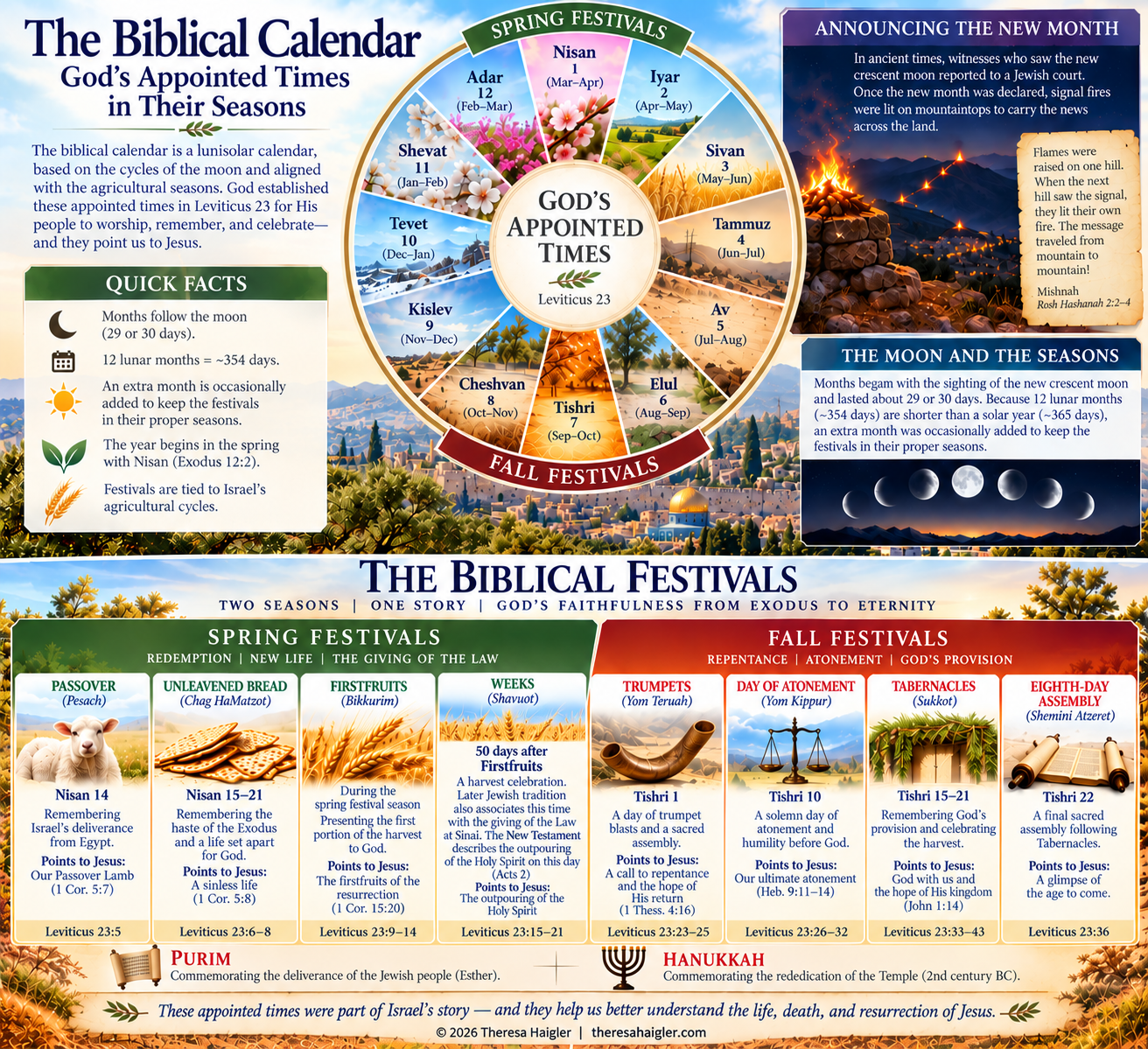
Why do biblical holidays move around on our modern calendar? Israel’s months followed the moon, but its festivals also needed to remain aligned with the seasons. This makes the Jewish calendar lunisolar.
A new beginning
In Exodus 12:2, God tells Moses that the month of Israel’s deliverance will be the beginning of months. Exodus calls this springtime month Aviv, a term associated with ripening grain; later Scripture calls it Nisan (Esther 3:7). The festival year begins with the season of the Exodus.
The moon, the sun, and the harvest
Twelve lunar months total roughly 354 days – about eleven days fewer than a solar year. Without adjustment, spring festivals would drift into other seasons. Jewish calendar systems used an additional month when necessary. Scripture ties the festivals to the seasons but does not give us an ancient calendar adjustment method; the fixed calculated Hebrew calendar developed much later.
A message across the mountains
How did communities know when a new month began? The Mishnah, compiled around AD 200, describes witnesses reporting the new crescent moon to a Jewish court. It also describes flaming signals passed from mountaintop to mountaintop to announce a new month, until misleading signals prompted a switch to messengers (Mishnah Rosh Hashanah 2:2–4). We cannot date every detail of this tradition to Jesus’ lifetime, but what a picture: one flame, then another, carrying news across the hills!
4. How the Biblical Holidays Point to Jesus
The festivals meant something real to Israel long before Jesus was born. They shaped the nation’s memory, worship, and hope. Reading the New Testament, we also find striking connections to His life and work.
Spring: redemption, new life, and harvest
Paul identifies Christ as “our Passover” (1 Corinthians 5:7), uses unleavened bread as an image of sincerity and truth (1 Corinthians 5:8), and calls the risen Jesus “the firstfruits of those who are asleep” (1 Corinthians 15:20). Acts 2 places the outpouring of the Holy Spirit on Pentecost, the Greek name for Shavuot.
Fall: gathering, atonement, and God’s presence
The New Testament describes Christ’s return with trumpet imagery (1 Thessalonians 4:16; 1 Corinthians 15:52), presents Jesus as our great High Priest whose sacrifice is sufficient (Hebrews 9-10), and celebrates God dwelling with His people (John 1:14; Revelation 21:3). These themes invite rich study, though the New Testament does not give an explicit future-event timetable for each fall festival.
We’ll distinguish what Scripture states directly from historical traditions and theological interpretations. We don’t need to force a connection to find something wonderful. Sometimes the text itself gives us more than enough to ponder!
5. Explore the Biblical Holidays
Choose a holiday to explore its biblical beginnings, history, traditions, and connections to Jesus. Select a holiday below to explore its individual study page.
The Sabbath
Shabbat – Genesis 2:2-3; Leviticus 23:3; Mark 2:27-28. Why does God begin with rest, and what does Jesus mean when He calls Himself Lord of the Sabbath? → Explore the Sabbath
The Spring Festivals
Passover (Pesach) – Exodus 12; 1 Corinthians 5:7. A lamb, a blood-marked doorway, and a night Israel never forgot. → Explore Passover
Unleavened Bread (Chag HaMatzot) – Exodus 12:15–20; 1 Corinthians 5:8. What can bread without leaven teach us about remembrance and holiness? → Explore Unleavened Bread
Firstfruits (Bikkurim) – Leviticus 23:9–14; 1 Corinthians 15:20. What does the first portion of a harvest have to do with resurrection hope? → Explore Firstfruits
Weeks (Shavuot / Pentecost) – Leviticus 23:15–21; Acts 2. From the wheat harvest to a remarkable gathering in Jerusalem. → Explore Shavuot
The Fall Festivals
Trumpets (Yom Teruah) – Leviticus 23:23–25. What did the trumpet blasts announce, and why does the New Testament use trumpet imagery? → Explore Trumpets
Day of Atonement (Yom Kippur) – Leviticus 16; Hebrews 9–10. A solemn day that opens a window into the work of our great High Priest. → Explore Yom Kippur
Tabernacles (Sukkot) – Leviticus 23:33–43; John 7. Temporary shelters, a joyful gathering, and Jesus’ invitation to the thirsty. → Explore Tabernacles
Two Later Celebrations
Hanukkah (Dedication) – John 10:22–39; 1 Maccabees 4:36–59. The Temple was rededicated-and John places Jesus there during the festival. → Explore Hanukkah
Purim – Esther 9:20–32. A threatened people, a courageous queen, and a remarkable reversal. → Explore Purim
6. Continue Exploring
The best place to begin is always Scripture. Read Leviticus 23 as a whole, then explore Exodus 12-13; Deuteronomy 16; Leviticus 16; John 7-10; 1 Corinthians 5 and 15; and Hebrews 9-10.
Helpful resources
Hebrew for Christians – https://www.hebrew4christians.com/ – Hebrew words, Jewish traditions, and Messianic reflections.
My Jewish Learning – https://www.myjewishlearning.com/ – Jewish holiday practices and historical background.
Sefaria – https://www.sefaria.org/ – Jewish texts, including the Hebrew Bible and Mishnah.
These resources represent different perspectives. We’ll keep distinguishing the biblical text, later customs, and Christian interpretations.
Listen along
The Biblical Holidays podcast series will follow these studies, beginning with the Sabbath. Episode links will be added as they are released.
So keep reading. Keep studying. And keep looking for Jesus throughout the pages of Scripture!

