
1. What Is Sabbath?
Sabbath was not merely a day off. It was sacred time.
The Hebrew Meaning of Shabbat
The Hebrew word Shabbat , pronounced shah-BAHT, is related to the Hebrew verb shavat, meaning “to cease,” “to stop,” or “to rest.”
Although we commonly think of rest as recovering from exhaustion, the biblical concept begins with ceasing from activity.
Sabbath therefore teaches something beyond physical relaxation. It establishes a rhythm of work and rest, reminding us that life is not defined entirely by labor, productivity, or accomplishment.
Sabbath and God’s Appointed Times
The Hebrew word translated “appointed times” in Leviticus 23:2 is mo’adim, the plural of mo’ed. A mo’ed is an appointed time or occasion. These were not simply celebrations that Israel developed independently. They were times God designated for His people.
There is something beautiful about Sabbath’s placement at the beginning of God’s appointed times. Before introducing the annual commemorations of deliverance, harvest, repentance, and dwelling with Him, God reminds Israel of a weekly appointment. Every seven days, ordinary work was to give way to sacred time.
Unlike the annual festivals, which occur on designated dates in the biblical calendar, Sabbath follows a recurring seven-day cycle.
In Jewish practice, Sabbath begins at sunset on Friday and continues until nightfall on Saturday. This reflects the biblical pattern of reckoning days from evening to evening, although the precise determination of when Sabbath ends is shaped by Jewish tradition.
Sabbath also differs from the annual festivals because its roots reach all the way back to Creation. Long before Israel gathered at Mount Sinai or received the Law, Genesis tells us that God blessed the seventh day and made it holy.
A Glimpse of Something Greater
Throughout Scripture, Sabbath is connected to several major themes: Creation, deliverance from Egypt, dependence upon God’s provision, and His covenant relationship with Israel.
In the New Testament, Jesus declares Himself Lord of the Sabbath (Mark 2:28), and the writer of Hebrews speaks of a Sabbath rest that remains for the people of God (Hebrews 4:9).
The significance of Sabbath extends far beyond refraining from work. It directs our attention toward the Creator, the Redeemer, and the rest God promises His people.
2. Sabbath at Creation – The Seventh Day
The story of Sabbath does not begin at Mount Sinai. It begins in the opening chapters of Genesis, at the completion of God’s creative work.
For six days, God formed and filled His creation. He established the heavens and earth, brought forth vegetation and living creatures, and created mankind in His own image.
At the end of the sixth day, God declared everything He had made “very good” (Genesis 1:31). But the creation account was not quite finished. There was still a seventh day.
Genesis 2:1–3 tells us that God completed His work and rested on the seventh day. The passage then makes two remarkable statements: God blessed the seventh day, and God sanctified it.
The seventh day was distinguished from the other six. It was set apart as holy.
The Meaning of God’s Rest
God’s rest did not mean that He was exhausted from creating the universe. Isaiah 40:28 reminds us that the Creator does not grow weary. Rather, God ceased His creative work because it was complete.
This is the meaning of the Hebrew verb shavat, introduced in Section 1.
God’s rest marked the completion of His creative activity, not a need to recover His strength. The seventh day therefore establishes a pattern of completion and rest that will become foundational to Israel’s understanding of Sabbath.
The Seventh Day Is Different
There is a fascinating literary detail in Genesis 1–2. Each of the first six days concludes with the familiar statement that there was evening and morning, followed by the number of the day. But the seventh day is different.
Genesis does not record the familiar evening-and-morning conclusion for the seventh day.
The account simply tells us that God completed His work, rested, blessed the seventh day, and sanctified it.
Scripture does not explicitly explain this omission. Some interpreters understand it as a literary way of emphasizing the unique nature of God’s rest. Others see it as suggesting that God’s rest has an enduring significance beyond the original creation week.
This interpretation becomes especially interesting in Hebrews 4, where the writer connects God’s seventh-day rest with the rest still available to His people.
However, the omission does not establish that the seventh calendar day literally never ended. It does show that Genesis gives the seventh day distinctive treatment.
The Number Seven and Completion
Throughout Scripture, the number seven frequently appears in contexts associated with completion, fullness, and sacred patterns.
The Hebrew word for seven is sheva, pronounced SHEH-vah.
Although sheva and Shabbat sound similar, they are not identical Hebrew words and should not be treated as having the same meaning.
Nevertheless, the seven-day creation pattern becomes foundational to the recurring cycles found throughout Israel’s appointed times.
- Seven days in a week, with the seventh set apart for rest.
- Seven weeks counted toward the Feast of Weeks (Shavuot).
- Every seventh year designated as a sabbatical year for the land.
- Seven cycles of seven years leading to the Year of Jubilee.
- Seven-day observances associated with the Feasts of Unleavened Bread and Tabernacles.
These recurring patterns connect Israel’s weekly rhythm of rest with the larger biblical calendar of worship, remembrance, and celebration.
Was Adam Commanded to Keep Sabbath?
This is an important distinction when examining the origins of Sabbath observance.
Genesis tells us that God blessed the seventh day and made it holy. However, Genesis does not explicitly record God commanding Adam and Eve to observe Sabbath. There is no recorded instruction requiring them to cease working on the seventh day, nor does the text describe Adam and Eve observing a weekly Sabbath.
Some Jewish and Christian interpreters understand the sanctification of the seventh day at Creation as establishing a pattern intended for all humanity. Others distinguish between God’s rest at Creation and the explicit Sabbath instructions later given to Israel. Both perspectives recognize the significance of Genesis 2, but they differ in how they understand its implications for human observance.
What is clear is that God blessed and sanctified the seventh day long before Israel became a nation. The foundation of Sabbath is rooted in Creation itself.
The First Thing God Made Holy Was Time
Before there was a tabernacle, a temple, an altar, or a priesthood, God sanctified the seventh day. The first thing Scripture explicitly describes God as sanctifying was not a physical location. It was a period of time.
The Hebrew verb translated “sanctified” is qadash, pronounced kah-DAHSH, meaning “to make holy” or “to set apart.”
Later in Scripture, God would designate holy places, objects, assemblies, and people. But in the creation account, He begins by setting apart a day.
This establishes an important principle: holiness is determined by God. The seventh day was not made holy by human observance. God Himself blessed and sanctified it.
A Question Worth Pondering – Adam’s First Full Day
We often think of Sabbath as a reward for working hard. Work six days, then enjoy a day of rest. But consider Adam’s experience.
According to Genesis 1:26–31, Adam was created on the sixth day. The very next day was the seventh day – the day God blessed and sanctified.
Adam had not yet spent six exhausting days working in the garden. He had only just been created!
From Adam’s perspective, God’s sanctified seventh day came before a full week of human labor.
Scripture does not tell us exactly how Adam spent that first seventh day, nor does it describe him observing a Sabbath command.
Nevertheless, the sequence invites a meaningful reflection.
Perhaps the biblical rhythm of rest is not merely about recovering from our work. It also reminds us to recognize and appreciate what God has already accomplished.
God’s work preceded Adam’s. His provision came before Adam’s labor.
And that relationship between God’s provision and human dependence becomes especially important in the next biblical account involving Sabbath: the miracle of the manna in Exodus 16.
3. Sabbath Before Sinai – The Miracle of the Manna
The Israelites had barely begun their journey out of Egypt when they encountered another difficulty. They were hungry.
God had delivered them from slavery, parted the Red Sea, and destroyed Pharaoh’s pursuing army. Yet only weeks after leaving Egypt, the people began grumbling against Moses and Aaron because they lacked food.
According to Exodus 16:1, Israel arrived in the wilderness of Sin on the fifteenth day of the second month after leaving Egypt. Since the Exodus occurred in the first month, Nisan, this places the event in the following month, commonly called Iyar.
In their hunger, the Israelites remembered the meat and bread they had eaten in Egypt. They even complained that they would have been better off dying there. Their hardship had caused them to look back favorably upon the very land where they had suffered under slavery.
God responded by providing food in the wilderness. But His provision would also become a test of obedience, teaching Israel to depend upon Him one day at a time.
Bread from Heaven
In Exodus 16:4, God told Moses that He would rain bread from heaven for the people. They were to gather a daily portion, following His instructions as a test of whether they would walk in His law.
That evening, quail covered the camp. The following morning, when the dew evaporated, a fine, flake-like substance appeared on the ground.
The Israelites had never seen anything like it. Exodus 16:15 records their reaction with the Hebrew expression man hu, traditionally understood as “What is it?” Moses explained that it was the bread the Lord had given them to eat.
The substance became known as manna.
Exodus 16:31 describes manna as white, resembling coriander seed, and tasting like wafers made with honey. Numbers 11:7–8 provides additional details about its appearance and preparation.
Each morning, the Israelites gathered manna according to their needs. When the portions were measured according to God’s instructions, those who had gathered much had nothing left over, while those who gathered little had no shortage.
However, they were not permitted to save any until the following morning. Some disobeyed and discovered that the manna they had kept overnight had bred worms and become foul.
God was teaching His people to rely upon His daily provision rather than attempting to secure their future independently of His instructions.
The Double Portion – Preparing for Sabbath
On the sixth day, the Israelites gathered twice the usual amount of manna. The people were instructed to prepare what they needed and save the remainder for the following day.
This instruction differed significantly from what God had commanded during the previous five days. Ordinarily, manna kept overnight spoiled. Yet when the Israelites preserved a portion in preparation for Sabbath, it did not become foul or breed worms (Exodus 16:24).
The same food that spoiled when saved contrary to God’s instructions remained suitable to eat when saved in obedience to them.
On the seventh day, no manna appeared on the ground. The Israelites were to eat what God had already provided. Nevertheless, some went out searching for manna and found none.
The contrast reveals an important aspect of the Sabbath command. God did not merely instruct His people to cease gathering food. He provided enough on the sixth day to make their rest possible.
The command to rest was accompanied by the provision necessary to obey.
Sabbath Before the Ten Commandments
One of the most significant details in this account is its place in Israel’s history.
The events of Exodus 16 occurred before God gave the Ten Commandments at Mount Sinai in Exodus 20. Therefore, the Israelites were receiving specific Sabbath instructions before the formal establishment of the Sinai covenant.
In Exodus 16:23, Moses identifies the seventh day as a holy Sabbath to the Lord. In verse 29, he explains that the Lord has given the Sabbath to His people.
When some Israelites disregard the instructions, God asks in Exodus 16:28 how long they will refuse to keep His commandments and instructions.
In the immediate context, God had already commanded the people how and when to gather manna. Their responsibility to obey those instructions did not depend upon the later proclamation of the Ten Commandments.
This raises another question: Did the Israelites already know about Sabbath before Exodus 16?
Some interpreters believe Sabbath observance was known before this event, possibly through a tradition extending back to Creation. Others understand Exodus 16 as the first explicit biblical introduction of Sabbath observance to Israel.
Scripture does not tell us precisely when the Israelites first learned about Sabbath. It does establish that Sabbath instructions were given before the Ten Commandments at Sinai.
Genesis 2 records God’s sanctification of the seventh day. Exodus 16 shows Him instructing His redeemed people in its observance.
Sabbath as a Gift – The Test of Trust
In Exodus 16:29, Moses tells the Israelites that the Lord has given them the Sabbath.
The Hebrew verb used here is natan, meaning “to give.”
This wording is significant because Sabbath is often understood primarily in terms of restrictions on work. Yet Exodus describes it as something God gave His people, accompanied by His provision for their needs.
The manna account also reveals two related tests of obedience. On ordinary days, the Israelites had to trust God enough not to hoard food for the following morning. On the sixth day, they had to trust Him enough to gather extra and preserve it for Sabbath.
In one circumstance, obedience meant not saving food. In another, obedience required saving it.
The difference was not the manna itself, but God’s instruction concerning it.
For six days, the Israelites gathered food. On the seventh, they rested from gathering. They could neither produce manna nor make it appear through their own efforts. Their responsibility was to receive what God supplied and follow His instructions.
The lesson was one of dependence. Israel’s survival ultimately rested upon God’s faithfulness rather than the amount of labor the people could perform.
This principle would appear again in the sabbatical year, when God commanded Israel to allow the land to rest and promised provision for the interruption of ordinary agricultural work (Leviticus 25:1–7, 18–22).
Centuries after the manna miracle, Jesus declared that the Sabbath was made for man rather than man for the Sabbath (Mark 2:27). Although He spoke in a different historical setting, His words are consistent with the picture of Sabbath as a gift intended for human benefit.
Manna, Sabbath, and Jesus – The Bread of Life
The manna account also provides a direct connection to Jesus.
In John 6, after feeding a multitude with five loaves and two fish, Jesus spoke with people who asked Him for another sign. They referred to the manna their ancestors had eaten in the wilderness.
Jesus explained that His Father gives the true bread from heaven. He then identified Himself as the Bread of Life (John 6:35).
The manna had sustained Israel’s physical life in the wilderness, but its provision was temporary. Those who ate it eventually became hungry again, and they remained subject to death.
Jesus offered something greater. He described Himself as the living bread that came down from heaven and promised eternal life to those who believe in Him (John 6:47–51).
The connection is especially meaningful because John explicitly records Jesus drawing upon the manna account to explain His identity.
In the wilderness, God provided bread to sustain His people. In Jesus, God provides the Bread of Life, through whom eternal life is offered.
There is also a related lesson in Jesus’ instruction to pray for daily bread (Matthew 6:11). Just as Israel learned to depend upon God for its daily needs, Jesus taught His disciples to look to their heavenly Father for provision.
Not every detail of the manna miracle should be treated as a prophetic symbol. Nevertheless, the connection between manna and Jesus is firmly established in John 6.
The manna sustained physical life for a time. Jesus, the Bread of Life, offers eternal life.
A Question Worth Pondering
For generations, the Israelites had lived under Pharaoh’s demands, where their lives were shaped by forced labor and production quotas. In the wilderness, God began teaching them a different rhythm—one in which obedience included both working and resting.
Each Sabbath required Israel to trust that the food God had already provided would be sufficient. Their needs did not disappear on the seventh day, but they were commanded to cease gathering because God had made provision for them.
The manna account therefore raises a question that remains relevant today:
Do we trust God’s provision only when we are actively working, or can we also trust Him when it is time to rest?
The miracle of the manna demonstrates that God’s people were learning more than how to gather food. They were learning to live in dependence upon the One who had delivered them from Egypt and promised to sustain them.
4. Sabbath in the Law — Remember and Observe
Exodus 20:8–11; Deuteronomy 5:12–15; Exodus 31:12–17
By the time the Israelites arrived at Mount Sinai, they had already experienced God’s miraculous provision of manna and received instructions concerning seventh-day rest. Now, at the foot of the mountain, God established the covenant commandments that would govern their relationship with Him and distinguish them from the surrounding nations.
Among the Ten Commandments was the instruction to keep the Sabbath holy. This commandment connected Israel’s weekly rest to two foundational events: God’s creation of the world and His deliverance of Israel from Egypt.
A Note About the Numbering of the Ten Commandments
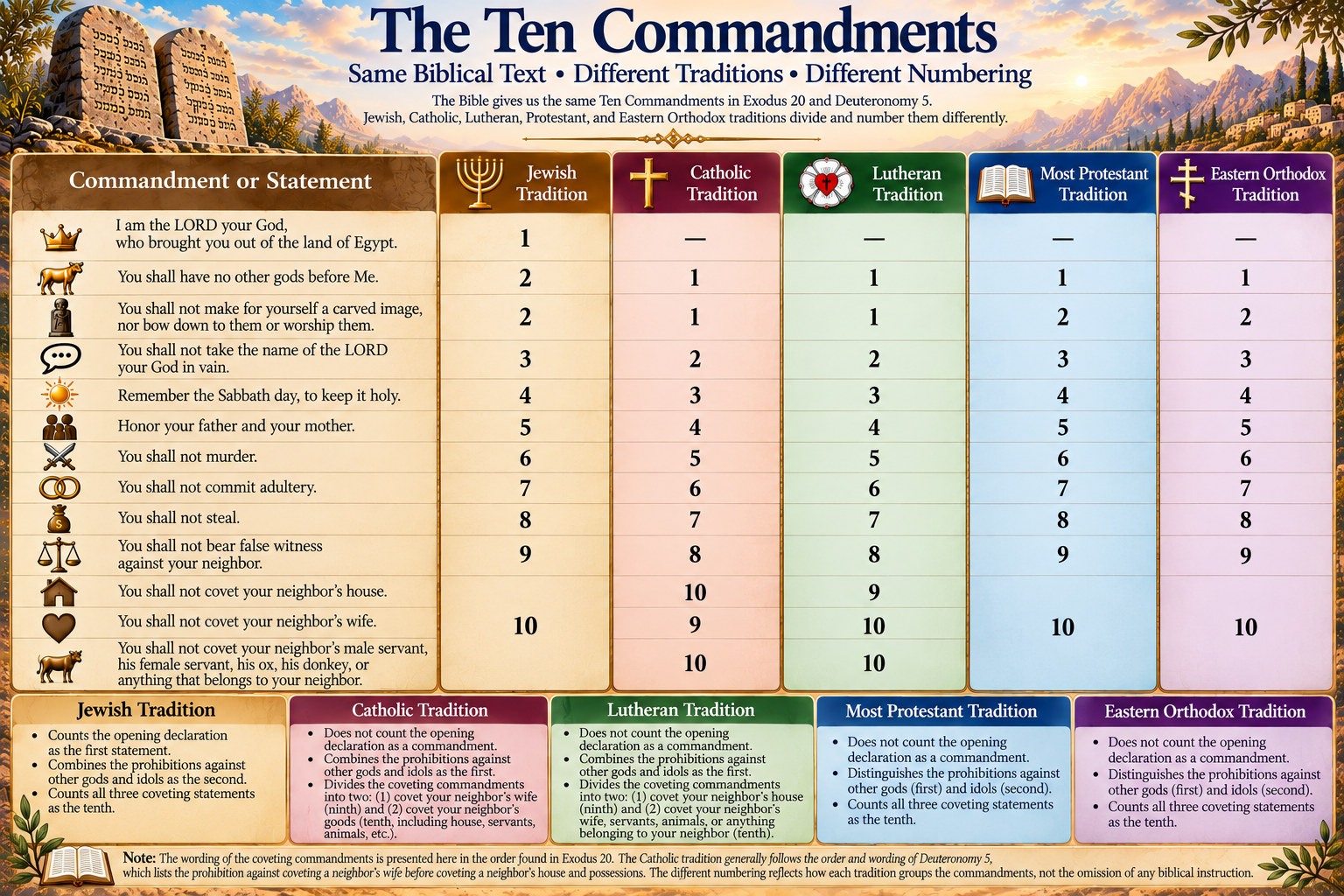
Jewish and Christian traditions do not all number the Ten Commandments in the same way. Most Protestants and Eastern Orthodox Christians identify Sabbath observance as the fourth commandment, while Roman Catholics and Lutherans identify it as the third. Traditional Jewish numbering places Sabbath fourth among the Ten Statements.
Scripture refers to the commandments as the “ten words,” or Aseret HaDevarim, pronounced ah-SEH-ret hah-deh-vah-REEM (Exodus 34:28; Deuteronomy 4:13), but does not assign individual numbers to them.
The differences arise from how traditions divide the same biblical text, particularly the commands concerning other gods, idols, and coveting. No commandment disappears from Scripture because its numbering differs.
Throughout this study, Sabbath will generally be identified as the fourth commandment, following the numbering familiar to most Protestant readers.
Remember the Sabbath – A Connection to Creation
In Exodus 20:8–11, God commands Israel to remember the Sabbath day and keep it holy. The people were to work for six days and rest on the seventh, extending that rest to their children, servants, livestock, and foreigners living among them.
God then gives the reason for the command: He created the heavens, earth, and sea in six days and rested on the seventh. Because of this, He blessed the Sabbath day and made it holy.
The Hebrew word translated “remember” is zakhor, pronounced zah-KHOR, from the verb zakhar, meaning “to remember” or “to call to mind.” In biblical usage, remembering can involve more than recalling information; it can include acting in response to what is remembered.
Israel was therefore commanded not merely to acknowledge the seventh day’s holiness but to demonstrate that recognition through obedience.
As established in Genesis 2, God had already blessed and sanctified the seventh day at Creation. At Sinai, He commanded Israel to remember and observe its holiness. This does not establish that Sabbath had been continuously observed since Adam, but it does connect the commandment directly to God’s creative work.
Observe the Sabbath – A Connection to Redemption
Approximately forty years later, Moses addressed a new generation of Israelites preparing to enter the Promised Land. In Deuteronomy 5:12–15, he repeated the Sabbath commandment, but with a different emphasis.
Rather than beginning with “remember,” the command begins with “observe.”
The Hebrew word is shamor, pronounced shah-MOR, from shamar, meaning “to keep,” “to guard,” or “to observe.”
While zakhor emphasizes remembering, shamor emphasizes carefully keeping what God has commanded. These ideas complement one another, but the most significant difference between the passages is the reason given for Sabbath observance.
In Exodus 20, God points back to Creation. In Deuteronomy 5:15, Moses points back to Israel’s deliverance from slavery in Egypt.
Exodus emphasizes God as Creator. Deuteronomy emphasizes God as Redeemer.
These are not competing explanations. They reveal two dimensions of the same commandment.
From Slavery to Rest
For a people who had experienced generations of forced labor, the command to rest carried particular significance.
In Egypt, the Israelites had labored under Pharaoh’s demands. Exodus describes the harshness of their service, including Pharaoh’s decision to increase their workload when Moses requested permission for the people to worship God (Exodus 5).
Now, the God who had delivered them from bondage commanded them to cease their ordinary labor every seventh day.
This rest was not limited to Israelite household heads. Deuteronomy 5:14 explicitly extended it to sons, daughters, male and female servants, foreigners, and working animals. Servants were to rest just as their masters did.
The Sabbath therefore had a social dimension as well as a spiritual one. It placed limits upon the demands people could make of those under their authority and reminded Israel of its own experience under oppression.
The people who had once been denied freedom from labor were commanded to extend regular rest to others.
Remember and Observe – Two Sides of the Same Command
Jewish tradition has long recognized the relationship between zakhor and shamor. The Babylonian Talmud teaches that the words “remember” and “observe” were spoken together in a single divine utterance (Shevuot 20b:9).
This is a later rabbinic interpretation, not a detail explicitly recorded in the biblical account. It nevertheless illustrates the importance Jewish teachers placed upon both expressions.
In traditional Jewish practice, remembering Sabbath is associated with honoring and celebrating the day, while observing Sabbath involves guarding its holiness through refraining from prohibited work.
Together, these ideas reflect a day intended to be both honored and faithfully observed.
Sabbath as a Sign of the Covenant
In Exodus 31:12–17, God identifies Sabbath as a sign of His covenant relationship with Israel.
The Hebrew word translated “sign” is ot, pronounced OHT, meaning a sign, mark, or distinguishing indication.
Other biblical covenants also involved identifying signs. The rainbow was given as a sign of God’s covenant with Noah (Genesis 9:12–17), while circumcision served as a sign of His covenant with Abraham and his descendants (Genesis 17:11).
In Exodus 31:13, God describes Sabbath as a sign between Himself and the children of Israel throughout their generations, reminding them that He is the Lord who sanctifies them. Ezekiel 20:12 reinforces this relationship, identifying the Sabbaths as a sign that Israel might know the Lord who made them holy.
This distinction matters when considering Sabbath observance among Christians. Although the seventh day was sanctified at Creation, Exodus 31 specifically identifies Sabbath as a covenant sign between God and Israel.
That does not settle every question concerning Christian Sabbath observance, but it establishes an important distinction between the creation foundation of Sabbath and its particular role within Israel’s covenant.
The Seriousness of Sabbath Observance
Because Sabbath was a covenant obligation, deliberate violations were treated seriously under the Mosaic Law.
Exodus 31:14–15 prescribed severe penalties for profaning the Sabbath, including death. Numbers 15:32–36 records an incident in which a man was found gathering wood on the Sabbath and was subsequently executed according to the Lord’s command.
These passages can be difficult for modern readers, particularly when Sabbath is also described as a gift. However, within Israel’s covenant, Sabbath was not simply an optional day of relaxation. It was a holy obligation established by God.
This helps explain the seriousness with which Sabbath observance was approached in later Jewish history. By the first century, Jewish teachers had developed detailed interpretations concerning what activities constituted prohibited work. Those interpretations and the controversies surrounding them provide important background for understanding Jesus’ Sabbath encounters in the Gospels.
The Sabbath and the Work of the Tabernacle
An easily overlooked detail appears in the placement of the Sabbath instructions within Exodus.
In Exodus 25–31, God gives Moses extensive directions concerning the construction of the tabernacle, the sacred dwelling place associated with His presence among Israel. Yet immediately after those instructions, God emphasizes the importance of Sabbath observance (Exodus 31:12–17).
The same pattern appears in Exodus 35:1–3, where Moses reminds the people of the Sabbath command before the construction of the tabernacle begins.
The work of building God’s sanctuary was holy and important, but even that work remained subject to His command concerning sacred time.
Doing something for God did not give Israel permission to disregard what God had commanded.
The placement of these passages illustrates that obedience to God was not secondary to religious activity, even when that activity involved constructing the place where Israel would worship Him.
Creation, Redemption, and Jesus
The two reasons given for Sabbath observance—Creation and redemption—also become central themes in the New Testament’s presentation of Jesus.
John 1:1–3 and Colossians 1:16–17 identify Christ as the One through whom all things were created. He is therefore directly connected to the Creation commemorated in Exodus 20.
Jesus is also central to God’s work of redemption. Through His death and resurrection, salvation and freedom from sin are made available to those who believe in Him.
The connection does not mean that the Sabbath commandment itself explicitly predicts every aspect of Jesus’ ministry. Rather, the New Testament reveals that Creation and redemption are both inseparably connected to Christ.
Israel was commanded to remember the God who created the world and delivered them from Egypt. Christians recognize Jesus Christ as the One through whom God created all things and accomplished redemption.
A Final Reflection
The Sabbath commandment called Israel to remember God’s completed work of Creation, acknowledge His deliverance from Egypt, and live faithfully within His covenant.
It was a command concerning holiness, but also one that provided rest for households, servants, foreigners, and animals.
Its significance extended beyond the absence of work. Sabbath reminded Israel of who God was, what He had accomplished, and what it meant to belong to Him.
5. The Sabbath Year and the Year of Jubilee
Leviticus 25:1–55; Deuteronomy 15:1–18
The weekly Sabbath was not the only pattern of rest God established for Israel. In Leviticus 25, He commanded that every seventh year the land itself was to observe a Sabbath.
This expanded the principle of rest beyond the individual household to the agricultural and economic life of the nation. The land was to rest, debts were subject to release, and after seven cycles of seven years, the Year of Jubilee brought additional provisions for liberty and restoration.
The Sabbath Year – When the Land Must Rest
When Israel entered the Promised Land, the people were permitted to cultivate their fields and vineyards for six years. During the seventh year, however, they were not to sow their fields, prune their vineyards, or carry out their usual harvesting activities.
This practice is commonly called Shemitah, pronounced sheh-mee-TAH, a Hebrew term associated with release or letting something drop. The word appears in Deuteronomy 15 in connection with debt release, while the related verb shamat appears in Exodus 23:11 concerning the land’s rest.
The seventh-year Sabbath did not mean that nothing could be eaten from the land. Leviticus 25:6–7 permitted its naturally occurring produce to provide food for the people, servants, hired workers, foreigners, livestock, and wild animals. The restriction concerned ordinary agricultural cultivation and harvesting, not the complete absence of food.
The command also reminded Israel that the land did not ultimately belong to them. In Leviticus 25:23, God declares that the land is His. Israel could occupy and cultivate it, but its use remained subject to His authority.
God’s Provision in the Sixth Year
The command to leave fields uncultivated for an entire year raised an obvious question: How would the people survive without their normal harvest?
God anticipated this concern in Leviticus 25:20–22. He promised to bless the sixth year’s harvest so that it would provide sufficient food through the seventh year and the following period of planting and waiting for new crops.
The reference to three years of provision reflects the agricultural timetable. After harvesting in the sixth year, the people would allow the land to rest in the seventh. They could resume planting in the eighth, but they would still need food until the next harvest became available.
This resembles the miracle of manna in Exodus 16. In the wilderness, God provided a double portion on the sixth day so Israel could rest on the seventh. In the Promised Land, He promised an abundant sixth-year harvest to sustain them during the land’s Sabbath.
In both accounts, God commanded rest and promised the provision necessary for obedience.
The promise in Leviticus 25 was specifically given to Israel within its covenant relationship with God. It should not be treated as a universal guarantee of extraordinary financial returns whenever Christians stop working. Nevertheless, the underlying lesson of dependence upon God’s faithfulness remains meaningful.
The Release of Debts – A Sabbath for the Debtor
The seventh year also involved the release of certain debts. Deuteronomy 15 instructed creditors to release qualifying obligations owed by fellow Israelites rather than continue demanding repayment.
The Hebrew term shemitah is used in this context, connecting the idea of release with the seventh-year cycle.
This law was particularly significant in an agricultural society where crop failures, poverty, or unexpected hardship could force families to borrow in order to survive. The recurring release placed limits on the economic claims one Israelite could exercise over another.
However, the law should not be described as universal cancellation of every debt. Deuteronomy 15:3 distinguishes debts owed by fellow Israelites from those owed by foreigners. Jewish interpreters have also discussed the precise timing and application of the release, with traditional rabbinic law understanding qualifying debts as canceled at the conclusion of the sabbatical year.
God also addressed the possibility that creditors might refuse to lend as the seventh year approached. Deuteronomy 15:7–11 warned Israel against withholding assistance from the poor simply because the approaching release might prevent repayment.
The law therefore concerned more than financial transactions. It required generosity and compassion toward those experiencing hardship.
A later Jewish legal development illustrates the practical difficulties surrounding this command. Rabbinic tradition attributes the prozbul (pronounced PROZ-bul) to Hillel the Elder, a Jewish sage associated with the period shortly before Jesus’ ministry. This legal arrangement allowed certain debts to remain collectible through a court procedure, addressing the problem of lenders refusing assistance before the sabbatical release. It is discussed in Mishnah Shevi’it 10 and Babylonian Talmud, Gittin 36a. The prozbul was a later rabbinic development, not part of Moses’ original instruction.
Seven Times Seven – The Year of Jubilee
After seven cycles of seven years, totaling forty-nine years, Israel was commanded to consecrate the fiftieth year as the Year of Jubilee.
The Hebrew word translated “Jubilee” is yovel, pronounced yoh-VEL, a term associated with the horn used in its proclamation.
Jubilee was closely related to the sabbatical cycle, but it included additional requirements involving the restoration of ancestral land and the release of certain Israelite servants.
Jewish interpreters have discussed how the fiftieth year relates to the continuing seven-year cycle. The straightforward reading of Leviticus 25 identifies Jubilee as the fiftieth year, while later legal discussions examine how that year was counted in subsequent cycles.
The Jubilee Horn Sounds on the Day of Atonement
One of Jubilee’s most significant details is the date of its proclamation.
According to Leviticus 25:9, the horn was to sound on the tenth day of the seventh month—the Day of Atonement, known in Hebrew as Yom Kippur , pronounced yohm kee-POOR.
This was one of the most solemn days in Israel’s calendar, associated with atonement and cleansing before God (Leviticus 16). Yet in the Jubilee year, it was also the appointed day for proclaiming liberty throughout the land.
The horn associated with this announcement is commonly called a shofar, pronounced shoh-FAR. Traditionally made from an animal’s horn, often a ram’s horn, the shofar appears in several important biblical settings, including God’s revelation at Sinai and Israel’s conquest of Jericho.
Its purpose in Jubilee was specific: to announce the appointed time for release and restoration.
Scripture does not explicitly explain why the Jubilee proclamation was assigned to the Day of Atonement. Nevertheless, the association is striking. The day associated with atonement was also the appointed day for proclaiming liberty.
Proclaim Liberty Throughout the Land
Leviticus 25:10 commands Israel to proclaim liberty throughout the land.
The Hebrew word translated “liberty” or “release” is deror, pronounced deh-ROR.
This word is especially important because it also appears in Isaiah 61:1, where the prophet announces liberty to captives. Centuries later, Jesus would read that prophetic passage in the synagogue at Nazareth.
In its original setting, however, Jubilee involved specific legal provisions within Israel’s covenant. Two of the most important concerned ancestral property and Israelites who had entered servitude because of poverty.
The Return of Ancestral Land
When Israel entered Canaan, the land was distributed among the tribes and families as an inheritance. Economic hardship could force a family to transfer the use of its property, potentially threatening its long-term inheritance.
The Jubilee legislation provided for the restoration of ancestral land. Leviticus 25:13 commanded Israelites to return to their property during the Jubilee year.
Because the land ultimately belonged to God, it was not to be permanently alienated from the families to whom it had been allotted. Leviticus 25:14–17 instructed that property transactions be valued according to the number of harvest years remaining until Jubilee.
In effect, the purchaser acquired the right to benefit from the land’s production for a limited period rather than permanent ownership of the ancestral inheritance.
The legislation included exceptions, particularly concerning certain houses in walled cities and property belonging to the Levites (Leviticus 25:29–34). Therefore, the Jubilee provisions did not apply identically to every kind of property.
The Kinsman-Redeemer Connection
Leviticus 25 also provided for a close relative to redeem family property before the Jubilee arrived.
If an Israelite became poor and transferred part of his property, a near relative could purchase it back on his behalf (Leviticus 25:25).
The Hebrew term associated with this responsibility is go’el, pronounced goh-EL, meaning a redeemer or one who acts to reclaim what has been lost.
This concept appears in the story of Ruth and Boaz. In Ruth 4, Boaz acts as a family redeemer in connection with property belonging to Naomi’s family and his marriage to Ruth. Although the legal circumstances in Ruth are not identical to every provision of Leviticus 25, both accounts illustrate the importance of family redemption.
For Christians, the language of redemption also points toward Jesus. The New Testament describes redemption through Christ, particularly deliverance from sin through His sacrificial death (Ephesians 1:7; 1 Peter 1:18–19).
The legal responsibilities of an Israelite go’el should not be treated as identical to every aspect of Christ’s redemptive work. Nevertheless, the shared theme is meaningful: restoration comes through the action of a redeemer.
The Release of Israelite Servants
Jubilee also provided release for certain Israelites who had entered servitude because of poverty.
Leviticus 25:39–43 instructed that an impoverished Israelite serving another Israelite was to be treated as a hired worker rather than subjected to permanent bondage. At Jubilee, he and his children were to return to their family and ancestral property.
God grounded this command in Israel’s deliverance from Egypt. The Israelites belonged to Him because He had brought them out of slavery (Leviticus 25:42).
An important distinction must be acknowledged: Leviticus 25:44–46 contains different provisions concerning non-Israelite slaves. Jubilee did not establish universal emancipation for every enslaved person in ancient Israel.
Its release provisions specifically addressed Israelite kinship, covenant membership, and ancestral inheritance.
For those covered by these provisions, Jubilee offered a remarkable opportunity for restoration. Economic hardship did not have to result in permanent separation from family property or indefinite servitude.
Did Israel Actually Observe Jubilee?
Although Leviticus 25 provides detailed instructions, the Old Testament does not give a clear narrative account of Israel carrying out a nationwide Jubilee exactly as commanded.
This does not prove Jubilee was never observed. It means the surviving biblical record does not establish its full historical implementation.
Later Jewish sources discuss the conditions under which Jubilee laws applied, including the relationship between observance and Israel’s tribes dwelling in their allotted territories.
The biblical command is clear; the extent of its historical observance is less certain.
When Israel Failed to Give the Land Its Rest
Leviticus 26:33–35; Jeremiah 25:11–12; 2 Chronicles 36:20–21
God warned Israel that persistent covenant disobedience would bring serious consequences, including removal from the land.
In Leviticus 26:34–35, He declared that during the people’s exile, the land would enjoy the Sabbath rests it had not received while they occupied it.
Centuries later, Judah experienced judgment through the Babylonian Empire. Jerusalem and the Temple were destroyed, and many inhabitants were carried into exile. Scripture presents this catastrophe as the result of a broad pattern of covenant unfaithfulness, including idolatry, injustice, and disregard for God’s commands.
However, 2 Chronicles 36:20–21 specifically connects the land’s desolation with its neglected Sabbaths and the fulfillment of Jeremiah’s prophecy concerning seventy years.
There is an intriguing calculation sometimes associated with this passage. Since the land was to rest every seventh year, seventy missed sabbatical years would correspond to 490 years.
70 × 7 = 490 years
Some Bible teachers have suggested that Israel had neglected the sabbatical years over such a period. The number also invites comparison with Daniel’s prophecy of seventy weeks in Daniel 9.
However, Scripture does not explicitly state that exactly seventy consecutive sabbatical years had been missed, nor does Chronicles provide a complete record of Sabbath-year observance. The 490-year calculation is an interpretation, not an established historical fact.
Jeremiah’s seventy-year prophecy also concerns Babylonian domination and God’s promised restoration, with its precise chronological boundaries interpreted differently by scholars.
What Scripture clearly establishes is that the land’s Sabbath rest mattered to God. The exile fulfilled His warning, but judgment was not the end of Israel’s story.
Following Babylon’s conquest by Persia in 539 BC, Cyrus issued a decree permitting Jewish exiles to return and rebuild the Temple (Ezra 1:1–4). The closing verses of 2 Chronicles connect this proclamation with the fulfillment of Jeremiah’s prophecy.
The land’s desolation demonstrated the seriousness of covenant disobedience. The return revealed God’s continuing faithfulness to His promises.
Jesus and the Proclamation of Liberty – The Jubilee Connection
The language of Jubilee reappears in Isaiah 61, where the prophet announces good news, liberty to captives, and the favorable year of the Lord.
The Hebrew word translated “liberty” in Isaiah 61:1 is deror, the same word used in the Jubilee proclamation of Leviticus 25:10.
This shared vocabulary provides an important connection between the original Jubilee legislation and the prophetic promise of restoration.
Centuries later, Jesus entered the synagogue in Nazareth on the Sabbath, as was His custom. He stood to read, received the scroll of Isaiah, and read a passage announcing good news to the poor, release to captives, recovery of sight to the blind, freedom for the oppressed, and the favorable year of the Lord (Luke 4:16–19).
Luke’s quotation reflects the Greek scriptural tradition and includes language corresponding to Isaiah 58:6 as well as Isaiah 61.
After reading, Jesus returned the scroll to the attendant and sat down. With everyone watching Him, He declared that the Scripture had been fulfilled in their hearing (Luke 4:21).
This announcement is especially significant in light of Luke’s preceding chapters. At Jesus’ baptism, the Holy Spirit descended upon Him (Luke 3:21–22). Luke then describes Him as full of the Spirit and returning to Galilee in the Spirit’s power (Luke 4:1, 14).
Now, in the synagogue, Jesus reads about the Spirit-anointed messenger and identifies His own ministry with the fulfillment of Isaiah’s prophecy.
The Hebrew word mashiach, meaning “anointed one,” gives us the title Messiah. Its Greek equivalent is Christos, from which comes the title Christ.
Why Did Jesus Stop Reading There?
Isaiah 61:2 includes both the proclamation of the Lord’s favorable year and the announcement of God’s day of vengeance.
In Luke 4, Jesus stops His reading after proclaiming the favorable year of the Lord.
Many Christian interpreters understand this as a distinction between the saving work emphasized during Jesus’ first coming and the final judgment associated with His future return.
That interpretation is consistent with broader New Testament teaching about salvation and judgment, but Luke does not explicitly explain why Jesus ended His reading at that point.
We can confidently observe that Jesus emphasized good news, release, and divine favor in His announcement. The proposed connection between the omitted words and the timing of future judgment remains a theological interpretation rather than an explanation Luke directly provides.
Was Jesus Announcing a Jubilee Year?
Because Isaiah 61 uses language associated with Jubilee, many Christian interpreters understand Jesus’ announcement as having Jubilee significance.
The connection is compelling. Leviticus 25 describes the proclamation of liberty and restoration. Isaiah 61 announces good news, liberty, and the favorable year of the Lord. In Luke 4, Jesus applies that prophetic announcement to His own ministry.
However, Luke does not state that Jesus was reading Isaiah during a literal Jubilee calendar year, nor does He announce that every legal provision of Leviticus 25 was being reinstated throughout Israel.
The relationship is therefore best understood as a strong biblical and theological connection, not proof that Jesus began His ministry in a particular fiftieth year.
A Greater Kind of Freedom
The original Jubilee legislation addressed real social and economic conditions within Israel: property, poverty, servitude, and family inheritance. Those historical realities should not be overlooked when considering their theological significance.
Yet the New Testament also reveals a deeper dimension of the liberation Jesus brings.
In John 8:34–36, Jesus teaches that sin brings slavery and that true freedom comes through the Son. Other New Testament passages describe His work as redemption from sin and death (Romans 6:17–23; Ephesians 1:7; Hebrews 2:14–15).
Jubilee provided a recurring opportunity for restoration within Israel’s covenant life. Jesus offers redemption through His life, death, and resurrection.
The Jubilee’s appointed year would eventually end. The salvation accomplished through Christ has eternal significance.
A Final Reflection
The Sabbath year and Jubilee reveal a remarkable progression in God’s instructions to Israel. Every seventh day brought rest from ordinary labor. Every seventh year brought rest for the land and release from certain debts. After seven cycles of seven years, Jubilee provided for the restoration of ancestral property and the release of certain Israelite servants.
These commands reminded Israel that time, labor, land, and possessions ultimately belonged to God.
The same themes of rest, release, and restoration appear in the prophetic writings, culminating in Jesus’ announcement at Nazareth that Isaiah’s promised message was being fulfilled.
The Sabbath taught Israel to remember its Creator. The Exodus revealed its Redeemer. The Jubilee proclaimed liberty and restoration. And in Jesus, the New Testament reveals the One through whom God accomplishes a greater redemption.
6. Jesus and the Sabbath
Matthew 12:1–14; Mark 2:23–3:6; Luke 6:1–11; John 5:1–18; John 9:1–41
The Sabbath in the Days of Jesus
By the time Jesus began His earthly ministry, the Sabbath had been part of Jewish life for centuries. It remained a distinguishing feature of Israel’s covenant identity, rooted in God’s work at Creation and His commandments at Sinai.
During the Second Temple period, Jewish teachers developed interpretations to help people apply the Torah to everyday circumstances. Sabbath observance raised practical questions about what constituted prohibited work and which activities were permissible when someone needed assistance.
The Pharisees were among the influential Jewish groups concerned with interpreting and applying the Law. Although the Gospels record significant disagreements between Jesus and certain Pharisees, we should not assume that every Pharisee opposed Him or that all Jewish teachers agreed on every question. Nicodemus, for example, was a Pharisee who came to Jesus with questions (John 3), and Acts 15:5 mentions believers from the party of the Pharisees.
Jesus Himself was Jewish, as were His earliest disciples. The Sabbath controversies recorded in the Gospels were therefore disagreements within first-century Jewish society about the interpretation of God’s commandments, not simply disputes between Christianity and Judaism.
What Counted as Work?
The Hebrew word often translated “work” in Sabbath legislation is melakhah, pronounced meh-lah-KHAH. It refers to work or an activity undertaken for a particular purpose.
The Torah identifies certain prohibited activities, including gathering manna on the seventh day (Exodus 16), kindling a fire in one’s dwellings (Exodus 35:3), and carrying burdens in the setting addressed by Jeremiah 17:21–22. However, it does not provide an exhaustive list covering every possible circumstance.
Later rabbinic literature identifies thirty-nine principal categories of prohibited Sabbath labor, known as the avot melakhot, or “primary categories of work.” Listed in Mishnah Shabbat 7:2, these include activities associated with agriculture, food preparation, textile production, writing, construction, and carrying objects between domains.
Rabbinic interpretation connects these categories with the labor involved in constructing the Tabernacle. This recalls the placement of the Sabbath command immediately before the Tabernacle construction instructions in Exodus 35.
An important historical distinction is necessary. The Mishnah was compiled around AD 200, although it preserves traditions that developed earlier. We should not assume that its completed list of thirty-nine categories was universally applied in precisely the same way during Jesus’ ministry.
Nevertheless, these traditions help us understand the kinds of questions surrounding Sabbath observance in the world Jesus entered.
The Grainfields – When Hunger Met the Sabbath
Matthew 12:1–8; Mark 2:23–28; Luke 6:1–5
One Sabbath, Jesus and His disciples were walking through grainfields when the disciples began picking heads of grain to eat. Some Pharisees challenged their actions, questioning why they were doing what was unlawful on the Sabbath.
The issue was not theft. Deuteronomy 23:25 permitted someone to pluck heads of grain by hand from a neighbor’s field, although using a sickle was prohibited. The controversy concerned whether the disciples’ actions constituted unlawful Sabbath work.
Luke adds that the disciples rubbed the grain in their hands before eating it (Luke 6:1). Later rabbinic classifications included reaping and threshing among prohibited activities, although the Gospel accounts do not specify precisely which formal categories the Pharisees believed had been violated.
Jesus responded by directing their attention to an event from David’s life.
In 1 Samuel 21:1–6, David and his companions were hungry, and David received consecrated bread that was ordinarily reserved for priests (Leviticus 24:5–9). The account does not explicitly state that this occurred on a Sabbath. Jesus used the incident to challenge His hearers’ understanding of sacred regulations and genuine human need.
Matthew records two additional points. Jesus reminded His opponents that priests carried out their Temple duties on the Sabbath without being considered guilty of violating it (Matthew 12:5). He then declared that something greater than the Temple was present (Matthew 12:6).
Jesus also quoted Hosea 6:6, emphasizing God’s desire for mercy rather than sacrifice. The Greek word translated “mercy” or “compassion” is eleos.
His response did not dismiss the importance of obedience. Instead, it challenged an interpretation that failed to recognize the place of mercy within God’s purposes.
In Mark’s account, Jesus explained that the Sabbath was made for humanity, not humanity for the Sabbath (Mark 2:27). The Greek word anthrōpos, translated “man,” refers here to human beings generally.
The Sabbath was intended for people’s benefit, not as a burden that prevented them from receiving necessary care.
The Son of Man Is Lord of the Sabbath
Jesus concluded the grainfield discussion with an extraordinary declaration: the Son of Man is Lord even of the Sabbath (Mark 2:28).
The title “Son of Man” is frequently used by Jesus throughout the Gospels. Although the expression can refer to a human being, it also carries important associations with Daniel 7:13–14, where one like a son of man receives dominion and an everlasting kingdom from the Ancient of Days.
The Greek word translated “Lord” is kyrios, pronounced KOO-ree-os, meaning lord, master, or one possessing authority.
Jesus was therefore claiming authority in relation to the Sabbath itself.
Consider the significance within the biblical story. God blessed and sanctified the seventh day at Creation. He commanded Israel to observe it at Sinai and identified it as a sign of His covenant. Now Jesus declared Himself Lord of that very day.
For Christians who recognize Jesus as the divine Son, this statement has profound significance. The One through whom all things were created (John 1:1–3; Colossians 1:16) speaks with authority concerning the day God made holy.
The grainfield controversy began with hungry disciples gathering food, but it ultimately raised a much larger question: Who is Jesus, and what authority does He possess?
Is It Lawful to Heal on the Sabbath?
Matthew 12:9–14; Mark 3:1–6; Luke 6:6–11; Luke 13:10–17; John 5:1–18; John 9:1–41
The grainfield encounter was not the only occasion when Jesus challenged particular interpretations of Sabbath observance. Several of His healing miracles took place on the Sabbath, revealing His compassion and authority.
The Torah prohibited ordinary work on the Sabbath but did not explicitly forbid healing. Jewish teachers debated how Sabbath restrictions applied to medical treatment, particularly when a condition was not immediately life-threatening. Later rabbinic tradition generally recognized the preservation of human life as grounds for setting aside Sabbath restrictions.
The Gospel controversies should therefore not be understood as though Judaism universally prohibited helping sick people on the Sabbath. The disagreements involved particular interpretations of the Law and, increasingly, the identity and authority of Jesus Himself.
The Man with the Withered Hand – Is It Lawful to Do Good?
Matthew 12:9–14; Mark 3:1–6; Luke 6:6–11
On another Sabbath, Jesus entered a synagogue where a man had a withered hand. Some religious leaders watched closely, hoping to find grounds for accusing Him if He performed a healing.
Jesus called the man forward and asked whether it was lawful to do good or harm on the Sabbath, to save life or to kill (Mark 3:4).
His question shifted the focus from whether healing constituted work to the moral significance of helping someone in need.
When His opponents remained silent, Mark records that Jesus looked at them with anger, grieved by the hardness of their hearts. He then instructed the man to stretch out his hand, and it was restored.
Matthew adds that Jesus compared the situation to rescuing a sheep that had fallen into a pit on the Sabbath. If an animal in distress deserved assistance, how much more valuable was a human being? Jesus concluded that it was lawful to do good on the Sabbath (Matthew 12:11–12).
Mark records a striking contrast. Immediately after Jesus restored the man’s hand, the Pharisees began conspiring with the Herodians about how to destroy Him.
Jesus had just asked whether it was lawful to save life or to kill on the Sabbath. His opponents responded to an act of healing by plotting His death.
The Woman Bent Over for Eighteen Years – A Daughter of Abraham
Luke records another Sabbath healing that connects especially well with the biblical themes of release and restoration.
While teaching in a synagogue, Jesus saw a woman who had been bent over for eighteen years and was unable to straighten herself. Luke describes her condition in spiritual as well as physical terms, and Jesus later states that Satan had bound her for eighteen years.
Jesus called her forward, declared her released from her infirmity, and laid His hands upon her. Immediately, she stood upright and began glorifying God.
The synagogue official objected because the healing had taken place on the Sabbath. He told the people that there were six days for work and that they should come for healing on those days.
Jesus responded by pointing to the ordinary practice of untying an ox or donkey and leading it to water on the Sabbath. If people would release their animals to meet their needs, why should this woman not be released from her bondage?
Jesus called her a daughter of Abraham.
That description is significant. He recognized her not merely as someone suffering from a physical condition but as a member of God’s covenant people.
The Greek vocabulary in this account includes forms related to lyō, meaning to loosen, untie, or release. Jesus connects the familiar act of untying an animal with the woman’s release from bondage.
The connection to our earlier study of Jubilee is worth considering. The Sabbath year and Jubilee involved specific forms of release from economic hardship and servitude. Here, on the weekly Sabbath, Jesus released a daughter of Abraham who had been bound for eighteen years.
Luke does not explicitly identify this healing as a fulfillment of Jubilee legislation. Nevertheless, the shared themes of bondage and release are meaningful.
The day associated with rest became the day this woman experienced freedom.
The Man at Bethesda – Take Up Your Mat and Walk
John records a Sabbath healing in Jerusalem near the pool of Bethesda, where a man had suffered from an infirmity for thirty-eight years.
Jesus asked whether he wanted to become well and then instructed him to get up, pick up his mat, and walk. The man was immediately healed.
Because the healing occurred on the Sabbath, the religious authorities objected to the man’s carrying his mat. This introduced an issue beyond the healing itself: Jesus had instructed him to carry an object on a day when certain forms of carrying were prohibited.
Jeremiah 17:21–22 warned against carrying burdens on the Sabbath, and later Jewish interpretation addressed transporting objects between different domains. The precise application of such restrictions to the man’s mat was part of the controversy.
When opposition intensified, Jesus made a remarkable statement in John 5:17, declaring that His Father continued working and that He Himself was working.
Genesis 2 describes God’s rest following Creation, but Jewish understanding of divine rest did not mean that God ceased sustaining the universe or exercising providential care.
Jesus connected His own activity with the continuing work of the Father.
John then explains that His opponents understood Him to be making a claim of equality with God, intensifying their desire to kill Him (John 5:18).
Once again, the controversy extended beyond Sabbath regulations to the question of Jesus’ identity.
The Man Born Blind – The Works of God Revealed
John also records the healing of a man who had been blind from birth.
Jesus made clay with saliva, applied it to the man’s eyes, and instructed him to wash in the pool of Siloam. The man obeyed and returned able to see.
John specifically notes that Jesus made the clay and opened the man’s eyes on the Sabbath.
Some Pharisees argued that Jesus could not be from God because He did not observe the Sabbath according to their understanding. Others questioned how someone they considered a sinner could perform such signs. The miracle produced division among them.
The healed man then became the subject of an extended investigation, with religious authorities questioning both him and his parents.
As the account unfolds, the significance moves beyond physical sight. The man who had been blind gradually comes to recognize more about Jesus, while others who claim spiritual understanding refuse to acknowledge what the miracle reveals.
By the end of the chapter, Jesus speaks about spiritual blindness and the responsibility of those who claim to see.
John uses the Sabbath healing to reveal both Jesus’ power to restore physical sight and the deeper question of whether people recognize the One sent by God.
What the Sabbath Healings Reveal
Each of these miracles highlights a different aspect of Jesus’ ministry.
The man with the withered hand reveals the importance of doing good and showing mercy. The woman bent over for eighteen years demonstrates Jesus’ compassion and authority to release someone from bondage. The healing at Bethesda leads to His declaration about the Father’s continuing work, while the man born blind becomes a testimony to the difference between physical and spiritual sight.
The circumstances differ, but the central themes remain consistent: compassion, restoration, and the authority of Jesus.
These healings were not merely attempts to provoke religious leaders. They were genuine acts of mercy toward people who were suffering. The controversies arose because those acts challenged particular interpretations of Sabbath observance and raised questions about who Jesus was.
We should not claim that every Sabbath healing was intended as a direct fulfillment of the Sabbath-year or Jubilee laws. The Gospel writers do not make that connection explicit in every account.
Nevertheless, the recurring themes of rest, relief, and release help us appreciate the character of the One who declared Himself Lord of the Sabbath.
Jesus, the Sabbath, and the Tomb
Matthew 27:57–28:6; Mark 15:42–16:6; Luke 23:50–24:6; John 19:38–20:9; Genesis 2:1–3
At Creation, God completed His work and rested on the seventh day. Near the conclusion of Jesus’ earthly ministry, another Sabbath occurred between His crucifixion and the discovery of His empty tomb.
Following Jesus’ death, Joseph of Arimathea received permission to take His body for burial. Nicodemus also came, bringing myrrh and aloes. Together, they prepared Jesus’ body according to Jewish burial customs and placed Him in a nearby tomb (John 19:38–42).
John explains that the tomb was close because it was the day of preparation. The Sabbath was approaching.
Luke adds that the women who had followed Jesus observed where His body was laid. They prepared spices and perfumes and then rested on the Sabbath according to the commandment (Luke 23:55–56).
Their actions illustrate how deeply Sabbath observance remained woven into Jewish life, even during an extraordinary time of grief.
A Sabbath Between the Cross and the Resurrection
Before Jesus died, John records His declaration, “It is finished!” (John 19:30).
The Greek word is tetelestai , pronounced teh-TEL-es-tie, from a verb meaning to complete, accomplish, or bring something to its intended end.
Jesus had accomplished the work the Father had given Him to do (John 17:4; 19:30). His body was then laid in the tomb, where it remained during the Sabbath.
Some Christian interpreters see a meaningful parallel between God’s completed work of Creation followed by seventh-day rest and Christ’s completed redemptive work followed by His body’s rest in the tomb.
Scripture records both events, but it does not explicitly identify Jesus’ time in the tomb as a fulfillment of the Creation Sabbath. The connection is therefore best understood as a theological parallel rather than a directly stated biblical teaching.
Nevertheless, the themes of completion and rest invite reflection.
The First Day of the Week – A New Beginning
All four Gospels place the discovery of the empty tomb on the first day of the week.
The women came expecting to attend to Jesus’ burial, but instead discovered that the tomb was empty. Jesus had risen.
The sequence has prompted many Christian interpreters to see a new-creation theme in the resurrection. In Genesis, the seventh day follows God’s completed work of Creation. In the Gospels, the Sabbath passes between Jesus’ crucifixion and the discovery of His resurrection on the first day of the week.
Paul later identifies Jesus as the firstfruits of those who have died (1 Corinthians 15:20), emphasizing that His resurrection is the beginning and guarantee of the resurrection hope promised to those who belong to Him.
Paul also describes believers as a new creation in Christ (2 Corinthians 5:17).
These New Testament teachings provide a theological basis for reflecting on the resurrection as a new beginning.
However, the first-day resurrection does not, by itself, explicitly establish that Sunday replaced the seventh-day Sabbath. The question of how the apostles and early Christians understood Sabbath observance and first-day gatherings requires separate examination.
A Final Reflection
Throughout the Gospels, Jesus’ Sabbath encounters reveal both His compassion and His extraordinary authority.
He defended His disciples, restored those who were suffering, and challenged interpretations that failed to recognize God’s mercy. He declared Himself Lord of the Sabbath and connected His work with the work of the Father.
Following His crucifixion, His body remained in the tomb during the Sabbath, and on the first day of the week His followers discovered that He had risen.
The connections between Creation, rest, redemption, and resurrection deserve careful consideration, even where Scripture does not explicitly identify one event as the fulfillment of another.
From the grainfields to the empty tomb, the Sabbath accounts repeatedly direct our attention toward Jesus—His mercy, His authority, and the redemption accomplished through Him.
7. The Sabbath, the Early Church, and Our Ultimate Rest
Acts 13:14–44; 16:13–15; 17:1–4; 18:4
Following Jesus’ resurrection and ascension, His followers began proclaiming the gospel throughout the Roman world. As the Church grew, important questions emerged concerning the Sabbath and the relationship between Jewish and Gentile believers.
The earliest followers of Jesus were Jewish. They had grown up observing the Sabbath, attending synagogue, and celebrating the biblical festivals. Recognizing Jesus as the Messiah did not immediately erase these familiar practices.
Throughout Acts, Paul regularly entered synagogues on the Sabbath to teach and proclaim Jesus. At Pisidian Antioch, he and Barnabas attended the synagogue, where Paul was invited to speak. The following Sabbath, a large crowd gathered to hear the word of the Lord (Acts 13:14–44). In Philippi, Paul and his companions visited a riverside place of prayer on the Sabbath, where they met Lydia (Acts 16:13–15).
These accounts demonstrate that Sabbath gatherings remained important settings for the proclamation of the gospel. However, we should distinguish between what Acts describes and what it commands. Paul’s synagogue attendance does not, by itself, establish that all Christians were required to observe the Sabbath in the same manner. Synagogues were natural places for Paul to reach Jewish audiences and others who worshiped Israel’s God.
What About the Gentile Believers?
As increasing numbers of Gentiles came to faith in Jesus, the early Church faced a significant question: Did these believers need to become Jewish and observe the Law of Moses in order to belong to God’s people?
Acts 15 records the apostles and elders gathering in Jerusalem to address this controversy. Some believers argued that Gentile converts should be circumcised and instructed to keep the Mosaic Law.
Peter reminded the assembly that God had given the Holy Spirit to Gentile believers and cleansed their hearts by faith. James then proposed instructions addressing matters involving idolatry, sexual immorality, and blood.
The resulting letter did not require Gentile believers to undergo circumcision or adopt the entire Mosaic Law. It also did not explicitly command them to observe the weekly Sabbath.
This omission is significant, although Christians disagree about its implications. Some understand it as evidence that Sabbath observance was not imposed as a covenant requirement upon Gentile believers. Others emphasize that the Jerusalem decree addressed particular controversies rather than providing a complete list of Christian obligations.
What is clear is that the apostles did not require Gentiles to become Jewish in order to receive salvation through Jesus Christ.
The First Day of the Week – A New Pattern of Gathering
Acts 20:7; 1 Corinthians 16:1–2; Revelation 1:10
The New Testament also records activities associated with the first day of the week, the day on which Jesus’ followers discovered His empty tomb.
In Acts 20:7, believers gathered on the first day of the week to break bread, and Paul spoke to them until midnight. This provides evidence of a Christian gathering on that day, although the passage does not explicitly state that Sunday had replaced the Sabbath.
In 1 Corinthians 16:2, Paul instructed believers to set aside money on the first day of each week for a collection. This establishes a weekly pattern of giving but does not necessarily describe a congregational worship service.
Revelation 1:10 introduces the expression “the Lord’s Day.” Many Christians understand this as a reference to Sunday, a day associated with Jesus’ resurrection. Early Christian writings outside the New Testament also provide evidence of Sunday becoming an important day for Christian gatherings. However, Revelation itself does not explicitly define the expression, and some interpreters understand it differently.
Taken together, these passages indicate that first-day gatherings developed among early Christians. They do not describe a universal, immediate transition in which every Christian community abandoned seventh-day Sabbath observance.
Did Sunday Replace the Sabbath?
Christians have understood the relationship between Sabbath and Sunday in different ways.
Some traditions regard Sunday as the Christian Sabbath, understanding the Sabbath principle as continuing under the new covenant with its observance centered on the Lord’s Day.
Others distinguish Sunday worship from the seventh-day Sabbath. They gather on Sunday to celebrate Christ’s resurrection without identifying that day as a direct replacement for the Sabbath commanded to Israel.
Still others, including Seventh-day Adventists and certain other Sabbath-observing Christians, maintain that the seventh-day Sabbath remains binding upon believers.
These differences arise from broader questions about the relationship between the Mosaic covenant, the new covenant, the Ten Commandments, and the resurrection of Jesus.
The New Testament does not contain an explicit command stating that the Sabbath was changed from the seventh day to the first day. It does, however, record first-day gatherings and teachings that Christians interpret differently regarding their obligations under the new covenant.
Understanding those passages requires careful attention to their context.
Let No One Judge You – Paul’s Teaching About Sacred Days
Colossians 2:16–17; Romans 14:5–6; Galatians 4:9–11
Paul addressed religious observances in several of his letters, particularly when disputes threatened the unity of believers or confused the relationship between faith and obedience.
In Colossians 2:16–17, he instructed believers not to allow others to judge them concerning food, drink, festivals, new moons, or Sabbaths. He described these observances as a shadow of what was to come, while the substance belongs to Christ.
The sequence of festivals, new moons, and Sabbaths resembles Old Testament references to annual, monthly, and weekly observances. Many interpreters therefore understand Paul’s statement to include the weekly Sabbath. Others argue that the immediate concern involves particular regulations and judgments surrounding religious observance rather than the Sabbath commandment itself.
In Romans 14:5–6, Paul discusses differing convictions about the significance of particular days. Some believers regard one day above another, while others regard every day alike. Paul instructs each person to be fully convinced in his own mind and to act in honor of the Lord.
Christians disagree about whether this passage includes the weekly Sabbath or concerns other disputed days.
In Galatians 4:9–11, Paul expresses concern about believers observing days, months, seasons, and years in a way associated with returning to religious bondage. Within the broader argument of Galatians, he strongly opposes reliance upon observance of the Law as the basis for justification before God.
These passages should not be reduced to a blanket condemnation of Christians who choose to observe a Sabbath or biblical festival. At the same time, they challenge the idea that religious observance can establish a person’s righteous standing before God.
Observing a day as an expression of devotion is not the same as depending upon that observance for salvation.
The Sabbath Rest That Remains
Hebrews 3:7–4:11; Psalm 95:7–11; Genesis 2:2
The writer of Hebrews brings the discussion of rest back to Creation.
In Hebrews 3–4, the author reflects upon Israel’s wilderness experience and the warning recorded in Psalm 95. Although the generation that left Egypt witnessed God’s miracles and received His provision, many failed to enter the Promised Land because of unbelief and disobedience.
Psalm 95 warns God’s people against hardening their hearts and speaks of those who would not enter God’s rest.
Hebrews uses this passage to show that God’s promised rest extends beyond Israel’s entrance into Canaan. Joshua had led the Israelites into the land, yet Psalm 95, written later, still spoke of entering God’s rest. Therefore, the promise had not been exhausted by Israel’s possession of the land.
The writer then quotes Genesis 2:2, connecting this promised rest with God’s rest on the seventh day of Creation.
The same rest introduced at the beginning of Scripture becomes part of the New Testament’s explanation of what remains available to God’s people.
Sabbatismos – A Sabbath Rest for the People of God
Hebrews 4:9 contains a particularly interesting Greek word: sabbatismos pronounced sab-bah-TIS-moss.
It is commonly translated “Sabbath rest” and occurs only here in the New Testament.
The word is related to Sabbath terminology and can convey the idea of Sabbath observance or celebration. Its use in Hebrews has prompted considerable discussion among Christian interpreters.
Some understand the passage as affirming the continuing importance of Sabbath observance for God’s people. Others understand the Sabbath language as describing the deeper rest believers experience through Christ, ultimately fulfilled in God’s eternal rest.
The immediate context emphasizes faith, obedience, and the continuing promise of entering God’s rest. Hebrews 4:11 urges believers to be diligent to enter that rest, while the preceding verses connect it with God’s completed work at Creation.
The passage therefore invites us to consider something greater than merely ceasing from ordinary labor. God’s rest is presented as a promise into which His people are called to enter.
Christians differ over the relationship between this promise and the continuing observance of a particular day. Nevertheless, the passage makes clear that the biblical theme of Sabbath rest has not disappeared. It remains important to the writer’s explanation of God’s promises.
Sabbath and the Promise of a New Creation
Isaiah 66:22–23; Revelation 21–22
The biblical story begins with Creation and the sanctification of the seventh day. Near the conclusion of Isaiah, we encounter another remarkable passage concerning the new heavens and new earth.
In Isaiah 66:22–23, God speaks of the enduring future of His people and describes worship before Him from new moon to new moon and from Sabbath to Sabbath.
Some interpreters understand this as indicating that Sabbath observance will continue in the future new creation. Others understand the language as prophetic imagery describing the continual and universal worship of God.
The passage clearly uses Sabbath language in its vision of future worship, but it does not explain every detail of how time and observance will function in the new creation.
Revelation 21–22 describes the new heaven and new earth, where God dwells with His people, death and mourning are removed, and the curse is no more.
Revelation does not explicitly establish a weekly Sabbath schedule for the new creation. Its emphasis is upon God’s presence, the removal of sin and death, and the everlasting life of His redeemed people.
Together, these passages encourage us to look beyond the present world toward the fulfillment of God’s promises.
Final Reflection – From Creation to Our Ultimate Rest
Our study began in Genesis, where God blessed and sanctified the seventh day. We followed Sabbath through Israel’s wilderness journey, the covenant at Sinai, the sabbatical year, and the Year of Jubilee.
We saw how the Sabbath commanded rest, encouraged dependence upon God’s provision, and reminded Israel of Creation and redemption. The Jubilee extended these themes through the language of release and restoration.
Then we encountered Jesus.
He declared Himself Lord of the Sabbath, restored people who were suffering, and announced the fulfillment of Isaiah’s message of good news and liberty. Through His death and resurrection, the New Testament reveals the redemption accomplished by the Messiah.
The early Church continued to wrestle with questions of Sabbath observance, sacred days, and the relationship between Jewish and Gentile believers. Christians still differ in their understanding of some of those questions.
Yet Hebrews directs our attention to a promise that reaches beyond the wilderness, beyond the Promised Land, and back to God’s own rest at Creation.
The invitation to enter God’s rest remains.
The Sabbath reminds us of what God has accomplished, calls us to trust His faithfulness, and directs our attention toward the rest He promises His people.
And throughout the pages of Scripture, the story continues to point us toward Jesus.

