
Genesis 5 just begs for a chart. There are way too many names and numbers to keep up with and to understand without a visual for help. In this chart, the years at the top begin at 0, creation. The numbers to the left of the life span show the year they were born from creation. The numbers at the right are their death dates. In the middle you see the numbers we have from Genesis 5. Genesis 5 ends with Noah but I continue the chart to Jacob. We will see the rest of the people in our study pretty soon. As you look over the chart, what interesting things do you see? I included some of my notes at the bottom of the chart.
Names always have meanings and these that lead up to the flood are very interesting. When you read them in order, you could get “Man appointed mortal sorrow, blessed God shall come down teaching, his death brings humiliation, rest.” Check out the following chart:

Just like Enoch, Noah “walked with God”. 2 Peter 2:5 calls Noah a “preacher/herald of righteousness”. That tells me that he shared God’s ways during the decades it took him to build the ark. Genesis 6:5 tells us that “man’s wickedness had become great in the earth and every intent of the thoughts of his heart was only evil continually.” In verse 11 it tells us that “the earth was filled with violence (hamas) ” Unfortunately, only Noah’s family heard his message and followed him into the ark. 8 people out of billions.
There is a misconception that only 2 of every kind of creature entered the ark. Actually, of the “clean animals” and “flying creatures”, there were 14 each.
Genesis 7:2-3 2 Of every clean animal you shall take with you seven of each kind, male and female; and of the animals which themselves are not clean two, male and female; 3 also of the flying creatures of the sky seven of every kind, male and female, to keep offspring alive on the face of the whole land.
Leviticus 11 gives the account of what is considered clean and unclean. It’s interesting to note that God already had this in place with Noah way before the written law came with Moses centuries later. Why would God have more clean than unclean on the ark? I think there are two reasons. First, for food. After the flood, people would be allowed to eat meat, but only what God considered “clean”. This was forbidden before the flood. Second, for sacrifice. Certain animals would be used to continue the rituals of sacrifice that began in the Garden with God.
While Noah had the animals boarding the ark, people were continuing to live like they always had and did not pay any attention to Noah. Jesus tells us in Matthew 24:37-39 37 “For just as the days of Noah were, so will be the coming of the Son of Man. 38 For in those days before the flood, they were eating and drinking, marrying and giving in marriage, until the day Noah entered the ark. 39 And they did not understand until the flood came and swept them all away. So shall it be at the coming of the Son of Man.
Once Noah and his family boarded the ark, “the LORD closed the door behind him”.
Interesting things about doors in Scripture:
Exodus 12:7 NIV “Then they are to take some of the blood and put it on the sides and tops of the doorframes of the houses where they eat the lambs.”
Exodus 12:23 NIV “When the Lord goes through the land to strike down the Egyptians, he will see the blood on the top and sides of the doorframe and will pass over that doorway, and he will not permit the destroyer to enter your houses and strike you down.”
Matthew 25:10-12 NIV 10 “But while they were on their way to buy the oil, the bridegroom arrived. The virgins who were ready went in with him to the wedding banquet. And the door was shut. 11 “Later the others also came. ‘Lord, Lord,’ they said, ‘open the door for us!’ 12 “But he replied, ‘Truly I tell you, I don’t know you.’”
Luke 12:23-25 NIV 23 Someone asked him, “Lord, are only a few people going to be saved?” He said to them, 24 “Make every effort to enter through the narrow door, because many, I tell you, will try to enter and will not be able to. 25 Once the owner of the house gets up and closes the door, you will stand outside knocking and pleading, ‘Sir, open the door for us.’ “But he will answer, ‘I don’t know you or where you come from.’
John 10:7 ESV 7 So Jesus again said to them, “Truly, truly, I say to you, I am the door of the sheep.
Revelation 3:7 7 To the angel of Messiah’s community in Philadelphia write: “Thus says the Holy One, the True One, who has the key of David, who opens and no one will shut, and who shuts and no one opens
So, what happened to everyone who did not get on the ark? They died and according to 1 Peter 3:18-20, their spirits ended up in a “prison” awaiting judgment: “18 For Christ also died for sins once for all, the just for the unjust, so that He might bring us to God, having been put to death in the flesh, but made alive in the spirit; 19 in which also He went and made proclamation to the spirits now in prison, 20 who once were disobedient, when the patience of God kept waiting in the days of Noah, during the construction of the ark, in which a few, that is, eight persons, were brought safely through the water.“
Here you see the New Testament confirming that only 8 people made it into the ark even though God was patiently giving them a chance with the Gospel being preached.
Most people think the flood lasted 40 days/nights, but that was only the rain. The flood actually lasted for just over a year. It took a lot of time for the waters to subside.
Genesis 7:23 NASB says 23 Thus He blotted out every living thing that was upon the face of the land, from man to animals to creeping things and to birds of the sky, and they were blotted out from the earth; and only Noah was left, together with those that were with him in the ark.
The Hebrew word “Machah” used for “blotted out” is the same word used in Isaiah 43:25 when God talks about blotting out our sin: 25 I, I am the One who blots out your transgressions for My own sake, and will not remember your sins. I like to say “there’s a flood in the blood!”
After 150 days, things begin to change. The turning point, “God remembers Noah”. The story of Noah has a perfect chiastic structure (mirror effect):

The next chart gives a great look at the amount of time everything took during the flood. Again, with so many dates and time frames recorded, a chart is helpful. Here are some interesting things to note with numbers:
Number 7: Symbolic of spiritual perfection (Genesis 2:2; Psalm 12:6; Matthew 18:22). Seven churches, seven spirits, seven gifts of the Holy Spirit, etc.
Number 8: Symbolic of a new beginning (Genesis 17:2; Mark 16:9-11; Genesis 7:13). Christ appeared eight times after His resurrection, God saved eight people from the Flood, newborns were circumcised on the eighth day. Also, think of things that start over on the 8th interval like, music scales, colors in the rainbow, days of the week, etc.
Number 12: symbolizes spiritual authority (Matthew 10:2-4; Revelation 7; 10:2-4). Twelve tribes, twelve apostles, Jacob had twelve sons, God ordered that twelve loaves of unleavened bread be present in the temple each week, etc.
Number 30: symbolizes dedication to a calling (Numbers 4:3; Luke 3:23; 2 Samuel 5:4). Aaronic priests were initially dedicated at 30 years old. Christ began His public ministry at 30 years of age, David was 30 years old when he began his reign over Israel.
Number 40: Symbolic of trials (Genesis 7:4; Exodus 24:18; Numbers 14:33; Matthew 4:2). Moses lived 40 years in the desert, 40 years in Egypt, and was on Mount Sinai for 40 days, Jonah preached in Nineveh for 40 days, Ezekiel slept on his right side for 40 days, etc.
Number 300: Symbolic of atonement The numerical value of the letter shin is 300. The shin, which stands for shuvah (penitence), also represents the Day of Atonement—Yom Kippur. The gematria of the word kapper (“atonement”) is 300.


This next chart shows how the flood corresponds to the Feasts of Israel that will be established during the time of Moses. Even before these Appointed Times were given to His people after the Exodus, God was already working them from the beginning.
Once they are finally off the ark, Noah gives the appropriate sacrifice with one each of the clean animals and it was a pleasing aroma to God (remember God taught that to Adam and Eve and they passed it down) and then God gives the covenant sign of the rainbow (His bow). All mention of rainbows in Scripture have a direct connection to the power and glory of God.
Articles on God’s bow:
Genesis 9:20-27 tells us about an unfortunate incident that happens. Noah and his family create a garden complete with a vineyard. This takes some time to mature so don’t imagine the wine was produced immediately after the flood. You can bet at least 3-4 years if not more went by before that first harvest of wine was produced. Noah ends up drinking too much one day and again there is nakedness and shame in a garden. The “Garden Curse” is back and the pattern continues. Check out this chart from The Bible Project Classroom:

Chapter 9 ends with with death of Noah but the story continues in chapter 10 while Noah is still alive. He lived 350 years after the flood, so don’t count him dead just yet. This is not written in chronological order. Chapter 10 brings us to the descendants of Noah.
Chapter 11 and the Tower of Babel
Three times the people in Babel said “Come, let us…” all in an attempt to make a city and a “name” or “Shem” for themselves. They didn’t want to follow Shem, who was the leader/priest of the world at that time. They wanted their own identity and Nimrod was the man for the job. They were also in direct defiance of God’s command to “fill the earth”. They were gathered around a central location and were not spreading out. Finally, God says “Come, let Us…” and then the languages are mixed up and the people are scattered. You see this reversed in Acts 2 when the Holy Spirit comes with tongues of fire helping everyone understand the Gospel message in their own languages.
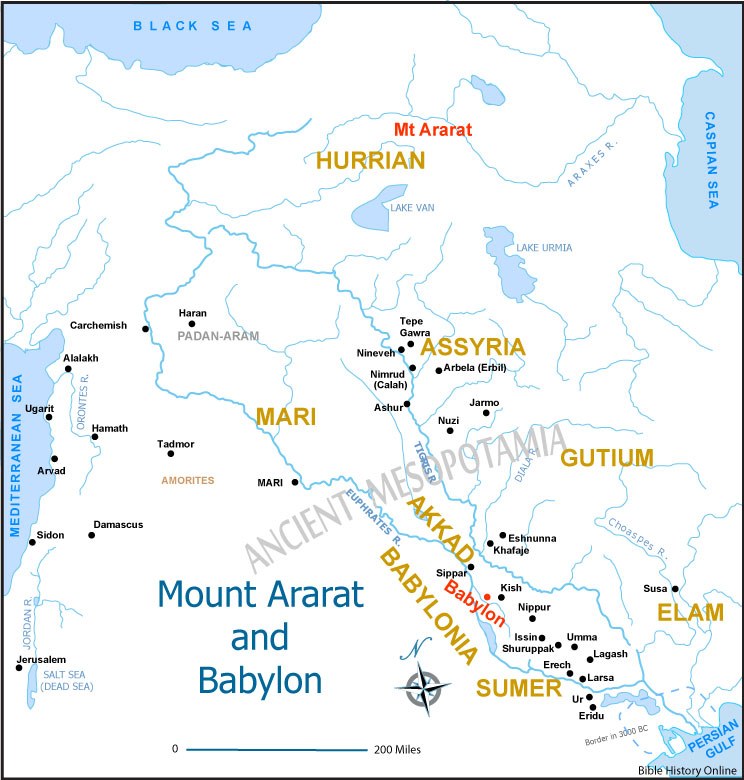
As the people begin to spread out over the earth, notice where they all overlap… Israel.

Extra Charts and Resources:
Articles:
Answers in Genesis blog: Noah the Evangelist
Answers in Genesis blog: Global Flood Traditions
Podcasts:
The Bible Recap podcast: Genesis 4-7
Knowing Faith podcast: #91 The Flood
Knowing Faith podcast: #92 Flood Actually
The Bible Project podcast: God’s Spirit in the Flood Narrative
Teaching Videos:
Cornerstone Chapel teaching video: Genesis 5-9 Lessons from the Flood
Cornerstone Chapel teaching video: Genesis 10-11 What’s the Babble at Babel About?
Mobile Site | Full Site
Get a free blog at WordPress.com Theme: WordPress Mobile Edition by Alex King.