
The book of Ruth concluded with a genealogy ending with David. Ruth 4:18-22 You can see the same genealogy listed in Matthew 1:1-6 but there the names of three women are listed as well. Tamar, Rahab and Ruth all get included with the men. Their stories are very familiar to us by now and we can understand why they were included in Matthew’s record. The next book is 1 Samuel but we don’t see anything about David until chapter 16. We first learn about the prophet/judge Samuel. Then we see the people asking for a king “like all the other nations.” This brings us to King Saul. He was 40 years old when he began to reign, and he reigned 32 years over Israel. Saul was of the tribe of Benjamin. Learn more about Saul here.
Fun fact: David is the most mentioned person in the Bible.
DAVID’S ANOINTING – LIFE AS SHEPHERD
David is the youngest of seven brothers making him the eighth son according to 1 Samuel 16:8-11. According to 1 Chronicles 2:13-15 he is the seventh son. For an answer to this difference, check out this article at Gotquestions.org.
David is out tending sheep when Samuel comes to anoint the next king. Each brother passes by Samuel and is then rejected. David is brought in and the LORD tells Samuel to anoint him immediately. Everyone invited to the sacrifice sees it. The brothers, David’s dad and the elders of Bethlehem are all witnesses. And then Samuel leaves and that’s all the information we get from that night. Everything seemed to go back to normal, except “from that day on the Spirit of the LORD came mightily upon David”. 1 Samuel 16:13
David ends up in the service of King Saul and comforts him after the LORD departs from him. David is described as “one who knows how to play the lyre. He is a brave man and a warrior. He speaks well and is a fine-looking man. And the Lord is with him.” 1 Samuel 16:18 During this time David goes back and forth between serving King Saul and helping his father tend flocks in Bethlehem. 1 Samuel 17:15
DAVID AND GOLIATH – LIFE AS WARRIOR
The Battle is a representative battle, otherwise known as Single Combat. Two individuals represent their people and face off in battle. Whoever wins this battle wins it for those he represents. Jesus did the same for us when He conquered death.
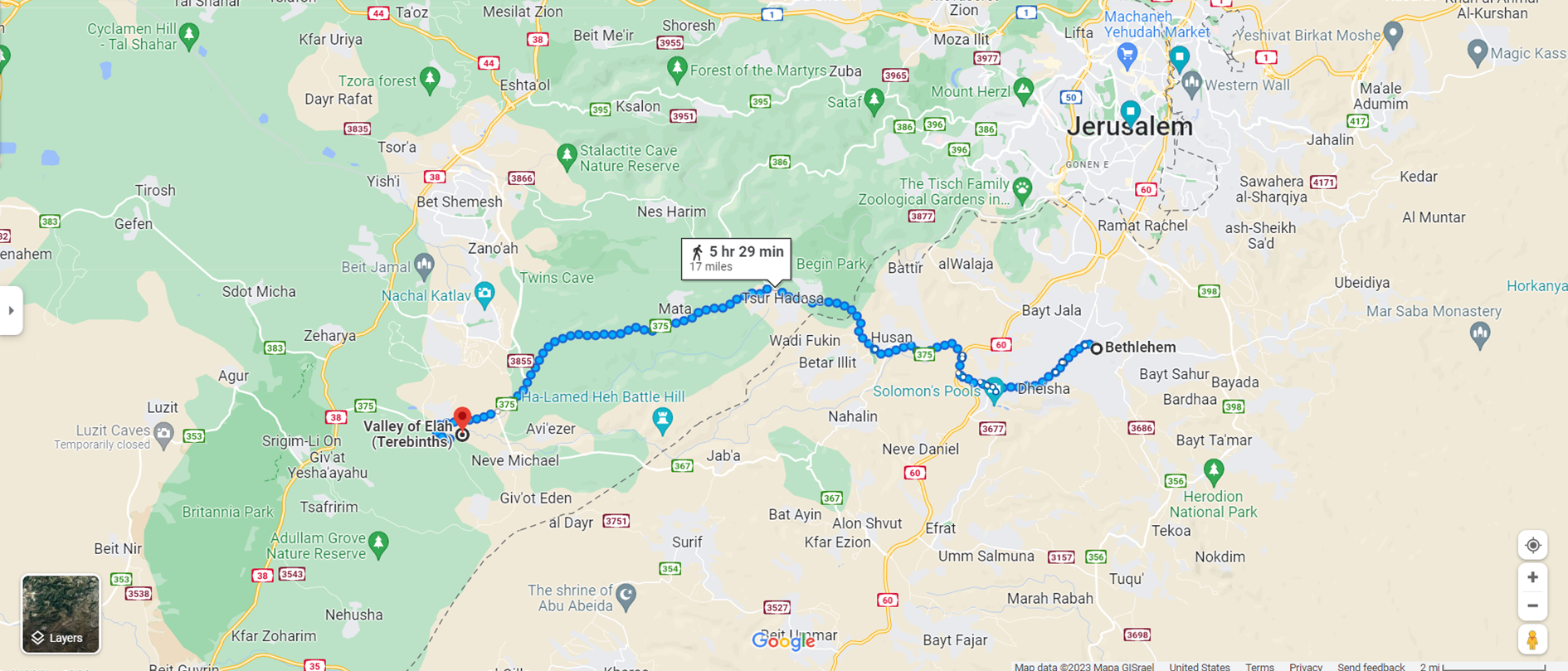
David was sent by his father in Bethlehem to his brothers in the Valley of Elah to bring them food and to check on them. He wanted a report when he got back. Everything changed when David heard the words of Goliath.
GOLIATH BATTLE FACTS:
- SIZE: The Masoretic text says of Goliath that he was 6 cubits & a span tall, while the Septuagint and the Dead Sea Scrolls say 4 cubits & a span. But whether he was 9’6″ or 6’6″, he was still likely a head or more taller than any of the Israelites, especially David who was just a “youth” and under 20 years of age.
- ARMOR: Bronze helmet, bronze scale-armor 5000 shekels in weight (125.66348945 lbs.), bronze shin guards on legs, shield with shield carrier
- WEAPONS: Bronze javelin, spear with shaft like a weavers beam and the head 600 shekels of iron (15.079621060587 lbs.), and a sword (which David uses to cut off Goliath’s head).
DAVID BATTLE FACTS:
- SIZE: The average height of a soldier was 5’8″. David was a teenager at this time.
- ARMOR: None. He tried on Saul’s but refused to wear it.
- WEAPONS: Stick (shepherd’s staff), a Shepherd’s bag, a sling and five stones, the Name of the LORD of Hosts
David wins the battle and doesn’t return to his father’s house again. Saul keeps him close and puts him over men in war. Over the next several years, Saul becomes jealous of David and tries to kill him. David remains loyal to the king, even sparing him when he has a chance to kill him. 1 Samuel 24
DAVID’S RULE: LIFE AS KING
David is 30 years old when he becomes king and he reigns a total of 40 years. During that time he ruled 7.5 years from Hebron and then 33 years from Jerusalem. 2 Samuel 5:1-10 David was the first person to conquer Jerusalem for Israel.
David extended the borders of Israel. This chart shows the areas of Israeli control under David, Solomon and today (white border):

God establishes the Davidic Covenant in 2 Samuel 7:1-17. First, He would bless the kingdom of David’s son, Solomon. He promised to be a father to Solomon, disciplining him but never forsaking him. Secondly, he promised that David’s throne would be “established forever.” In this, we see the promised Messiah, Jesus Christ. He was a descendant of the house of David. His kingdom will be forever (Psalm 45:6-7).
David has many wives and concubines but that doesn’t stop him from taking Bathsheba. There are many crossroads here:
- David stayed in Jerusalem instead of going out to war with his army.
- David saw Bathsheba. He should have turned away instead of continuing to watch.
- David sent messengers to inquire about Bathsheba. Once he learned who she was, he should have left her alone.
- David slept with Bathsheba.
- David learned she was pregnant. He should have repented and come clean.
- David learns Uriah is loyal to him and doesn’t go to his wife during a battle. He should have honored Uriah.
- Bathsheba mourns her husband.
Only after the confrontation with Nathan the Prophet does David finally choose the right road of repentance. 2 Samuel 12:1-15
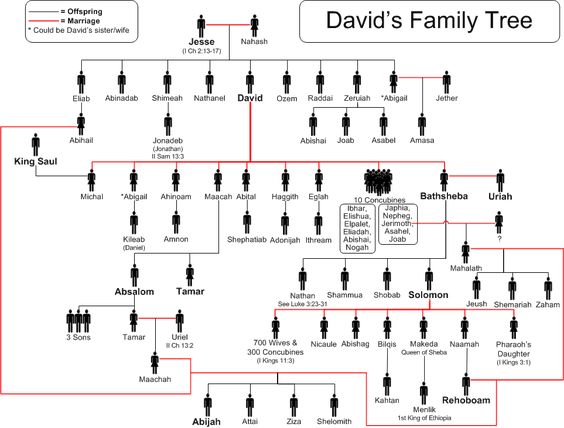
Solomon is eventually born to David and Bathsheba. Through Solomon, the Davidic covenant will continue. This occurs even though David has many descendants through many women.

Extra Charts & Resources:
Articles:
Holy Land Site: Valley of Elah
Insights on the Bible: 1 Samuel
Insights on the Bible: 2 Samuel
Teaching Videos:
The Bible Project Video: 1 Samuel – Bible Book Overview
The Bible Project Video: 2 Samuel – Bible Book Overview
The Bible Project Video: David the Priestly King
The Bible Project Video: The Covenants
Cornerstone Chapel teaching video: 1 Samuel 16
Cornerstone Chapel teaching video: 1 Samuel 17
Cornerstone Chapel teaching video: 1 Samuel 21-26
Cornerstone Chapel teaching video: 2 Samuel 2-5
Cornerstone Chapel teaching video: 2 Samuel 11
 Theresa Haigler